


What Is Data Cleaning? a Clear Guide for 2026

14/10/2026

10 Mins

Data cleaning is the controlled process of finding, fixing, standardising and documenting errors in records so the data is fit for purpose. On a refurbished phone, that means wiping the handset, validating the catalogue entry, and proving both were done properly.
In Plain English
- What it is: A controlled check-and-fix process, not a quick tidy-up.
- What it fixes: Missing values, duplicates, invalid formats, inconsistent codes and other record errors.
- Why it matters on a phone: A clean listing and a clean handset are two different jobs, and both have to be right.
- Simplest way to think about it: One track cleans the device, the other cleans the record about the device.
- Useful extra reading: If you want a straightforward example of correcting inconsistent data formats, that’s a decent place to start.
For customers, that usually shows up at trade-in, sale, repair handover or resale. The record needs to say the right things about the phone, and the phone itself needs to be cleared in a way that leaves no personal data behind. Our refurbished phone guide explains the same idea in a more shop-floor way, with the paperwork side kept separate from the wipe side. Used Mobiles 4 U refurbished phone guide
In Plain English What Data Cleaning Actually Means
What is data cleaning? It’s the disciplined process of spotting defects in data, correcting what can be corrected, and documenting what was done. In UK guidance, that means more than deleting obvious mistakes, it means checking whether a record is valid, consistent, complete enough for the job and traceable through the checks that were applied. The same logic applies whether you’re looking at a spreadsheet, a stock file or a phone listing.
On a handset, the key point is that there are two separate clean-ups. One is the device itself, where accounts, backups, messages and stored personal data have to be removed. The other is the catalogue record, where IMEI, grade, storage, colour, battery health and network status need to be accurate. If only one of those is clean, the job isn’t finished.
That’s why the best shorthand is simple, a clean record is one that’s reliable for the job it’s being used for. UK government guidance also stresses that quality checks should be built into the process, not bolted on at the end, and that defects should be investigated rather than waved through. For a broader lens on the same idea, the article on dati impeccabili con Electe is useful because it shows how duplicate handling fits into a controlled workflow.
Data cleaning is not a cosmetic tidy-up, it’s a decision process with evidence attached.
From Spreadsheet Tidy-Up to Controlled Quality Process
Most people hear “data cleaning” and think of deleting blanks, fixing typos and removing duplicate rows. That’s part of it, but it misses the real point. In a refurbished phone business, a line in a spreadsheet can affect stock, warranty, pricing, privacy and the next owner’s expectations, so the standard has to be higher than “looks neat”.
The UK Government Data Quality Framework treats quality as something you manage with rules, baselines, ownership and review over time. A field like storage should match a controlled vocabulary, a grade should never be blank, and a SIM-free status can’t contradict a network-lock field. That’s why we prefer logged corrections over quiet edits, because the reason for a change matters as much as the change itself. The same mindset appears in broader UK statistical guidance, where checks happen close to source, against previous periods, and against other known sources.
Practical rule: If you can’t explain why a value changed, you haven’t really cleaned it, you’ve only moved it.
That’s also why a decent clean has an owner. Someone decides which rule applies, someone reviews exceptions, and someone signs off when the record is safe to use. The safest way to think about it is that cleaning is ongoing control, not a one-pass rescue job at the end of a messy file.
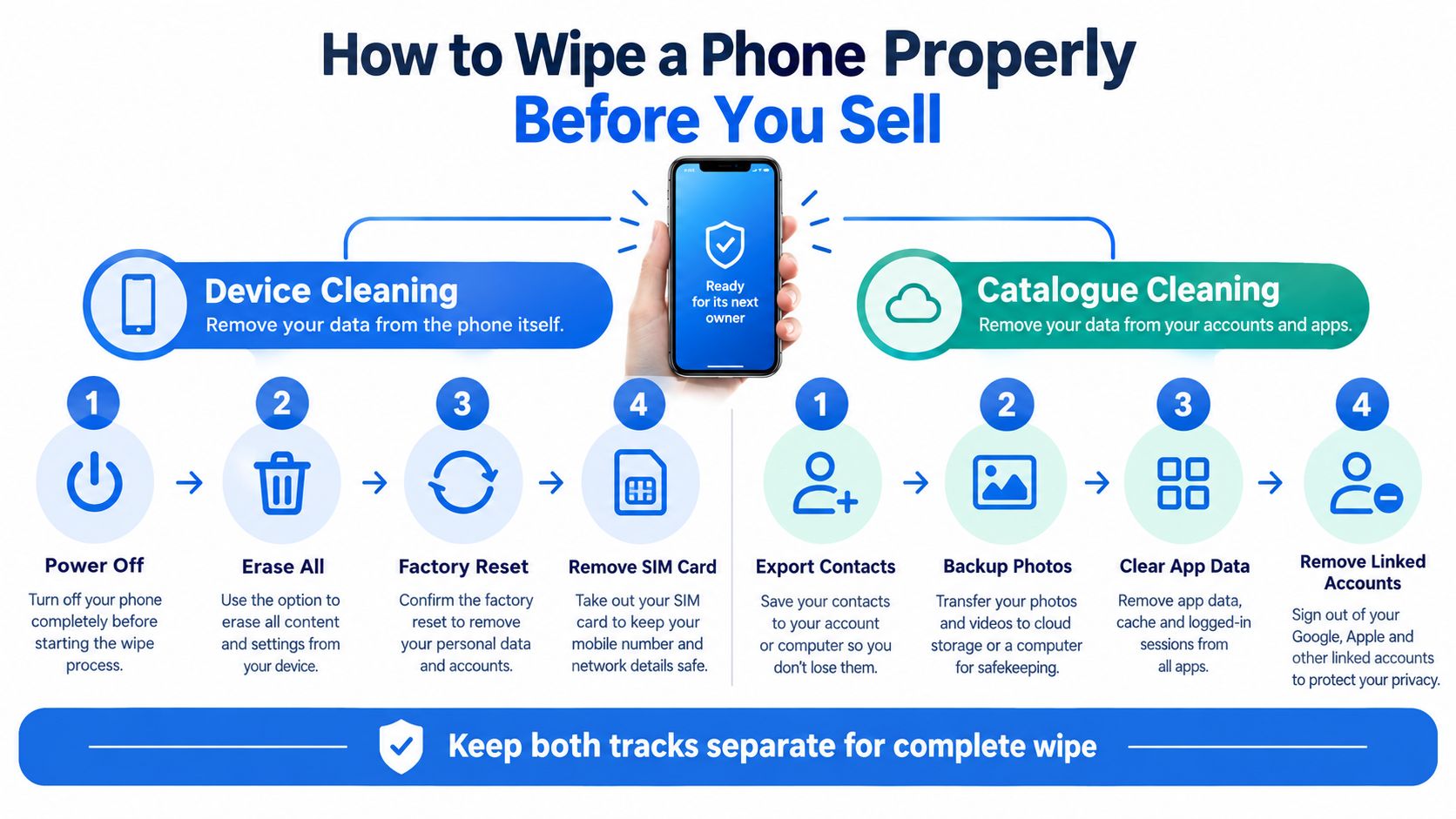
A useful shop-floor comparison is the way we separate device checks from listing checks on intake. The phone can be in perfect physical shape and still have a bad record, or the record can be clean while the device still carries old data. Our refurbishment notes are built around that same split, and the 10-step check page shows how those controls sit in a real workflow. Used Mobiles 4 U 10-step refurb check
How to Wipe a Phone Properly Before You Sell
Do this before anything else: back up your phone first, because a proper wipe removes data that you won’t get back. A factory reset is the end of the process, not the first tap you make.
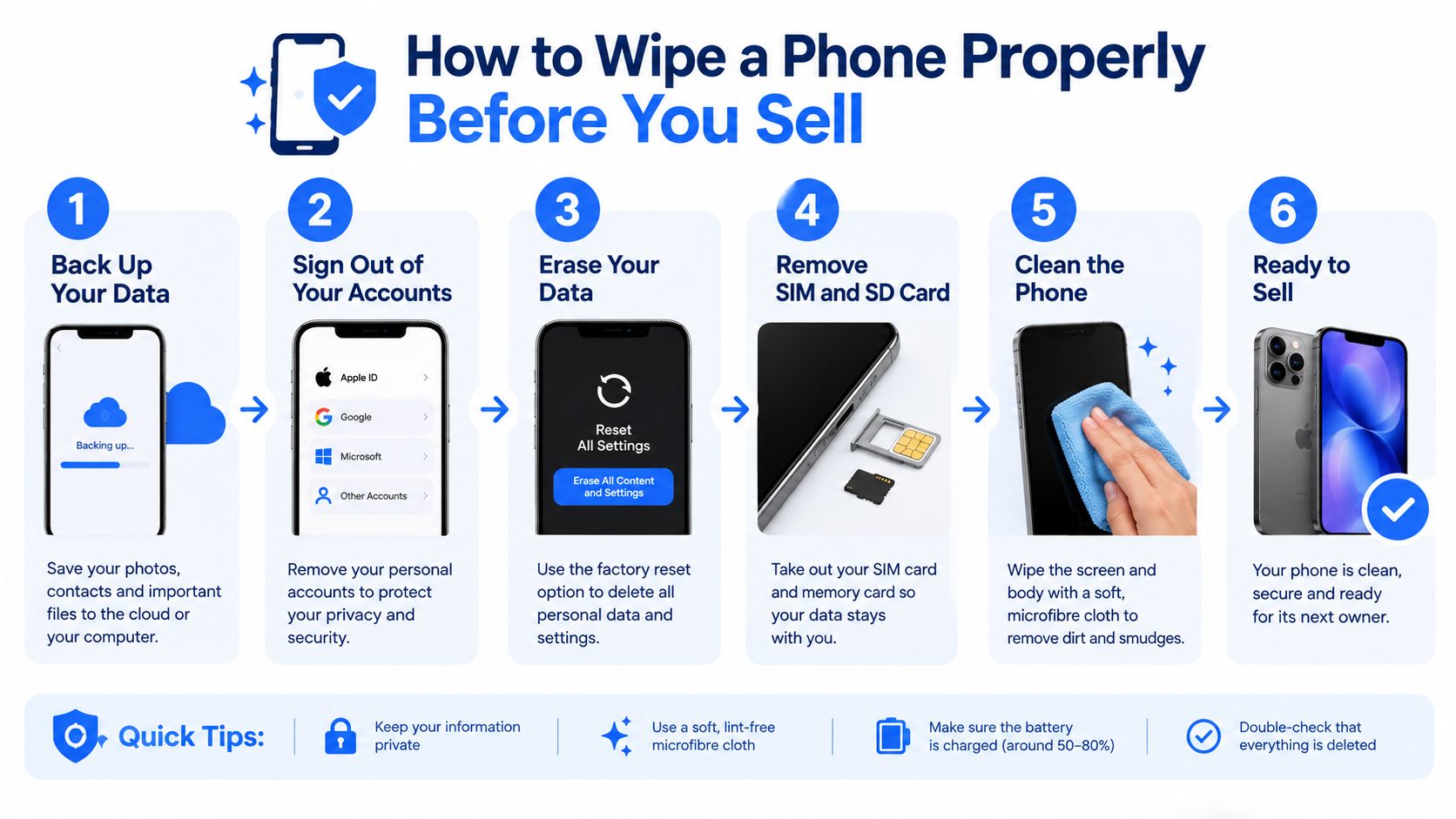
Start with the accounts and the content that live on the handset. Remove photos, messages, downloaded files, saved passwords, backups and any removable storage, then sign out of linked services. On an iPhone, the path is usually Settings > General > Transfer or Reset iPhone > Erase All Content and Settings, but the exact route depends on the device, so use the manufacturer’s own steps rather than a shortcut you found in a hurry.
That matters because signing out of one app isn’t the same thing as a clean phone. A device can look empty and still hold account data, cached messages or backup remnants, which is why the ICO treats proper deletion as a real privacy task, not a visual tidy-up. If you want a plain explanation of why residual data can still expose someone after resale, what identity theft actually is gives the wider risk in simple terms.
Don’t trust a reset you haven’t checked. If the phone boots straight back to a welcome screen, that’s the point where you start believing the wipe, not before.
Then do the catalogue side with the same care. IMEI must be unique, grade has to match the device, storage and colour need to line up with what’s in hand, and battery health and warranty status should be recorded honestly. If those fields are wrong, the listing becomes misleading even if the handset itself was wiped correctly. Our trade-in wipe guide covers the same handover logic for sellers who only have one device to prepare. Used Mobiles 4 U trade-in wipe guide
What We Check Before Resale on Refurbished Handsets
A common shop-floor issue is a handset that passes the physical bench but fails the paperwork bench. We’ve seen devices come in with a proper wipe done, then a missing IMEI check or an unsigned grade note creates rework later because the listing team can’t safely publish it. The fix is simple, but only if the checks happen in the right order.
- IMEI validity and uniqueness: We confirm the identity of the phone first, because everything else sits on that number.
- Network and SIM-free status: The listing has to match the lock state, or the buyer gets the wrong expectation.
- Grade field and photo match: A grade without evidence is too easy to guess at, so we compare the written condition with the handset photos.
- Battery health reading: Eligible refurbished phones need to meet our own minimum standard at sale, and anything that looks inconsistent gets reviewed rather than guessed.
- Storage, colour and variant mapping: These are controlled values, not free-text labels.
- Wipe status and battery cover flags: The record has to show whether the device was wiped and what cover applies.
- Final quality-control pass: A last human check catches the exceptions that automation misses.
One thing we regularly notice is that the awkward cases are the ones worth slowing down for. If a battery reading doesn’t fit the rest of the repair history, or a grade photo doesn’t match the description, that record goes to a technician rather than being auto-fixed. That keeps the catalogue honest and avoids hiding a real issue under a neat label.
Used Mobiles 4 U how refurbished iPhones data wiped
Why Clean Records Make a Phone More Likely to Be Reused
Clean data helps a phone stay in the reuse chain. If the condition is described clearly, the wipe is verified and the listing is complete, the device is more likely to be resold safely instead of being pushed straight towards recycling or written off as too uncertain to handle. That’s not just paperwork, it’s what makes reuse practical.
The environmental logic is straightforward. A Green Alliance report says UK households have up to 880 million unused electrical items in drawers, including phones, tablets and laptops, and that only 14% of electrical and electronic equipment is diverted for reuse, compared with 53% sent for recycling. Those figures show why a trustworthy listing matters, because a buyer is far more likely to choose reuse when the device record is complete and the wipe is visible. Green Alliance report on unused electrical items and reuse
A clean record also protects the buyer’s confidence. If someone sees battery status, cosmetic grade and wipe evidence laid out plainly, they can decide whether the phone suits them without chasing missing details. That’s especially important with refurbished smartphones UK buyers want to use straight away, because the record is part of the value, not an extra.
Reuse starts with trust. If the record looks careless, the phone looks risky, even when the handset itself is fine.
Three Common Mistakes That Make Data Dirtier
The first mistake is over-cleaning. A genuine but unusual record can look like a duplicate, a low-stock colour can look like a typo, and a one-off trade-in can get deleted simply because it doesn’t fit the pattern. That’s how you lose useful information and make the dataset worse, not better.
The second mistake is mixing up the catalogue with the handset. A tidy spreadsheet doesn’t prove the phone is safe to resell, and a wiped phone doesn’t prove the listing is honest. Those are separate controls, and both have to pass.
Don’t let a rule delete an exception just because it’s inconvenient.
The third mistake is skipping human review on edge cases. If a battery result, model code or grade photo doesn’t line up, that’s a review job, not an automatic overwrite. The best definition of clean data is still the practical one, information that’s trustworthy for the stated use while preserving provenance, privacy and accountability.
Quick Steps Before You Sell or Trade In Your Old Phone
Before you start: back up first, because a proper reset removes content you may still need. If you’re preparing one phone at home, the safest route is to move slowly and check each step once, not to rush and hope the factory reset covered everything.
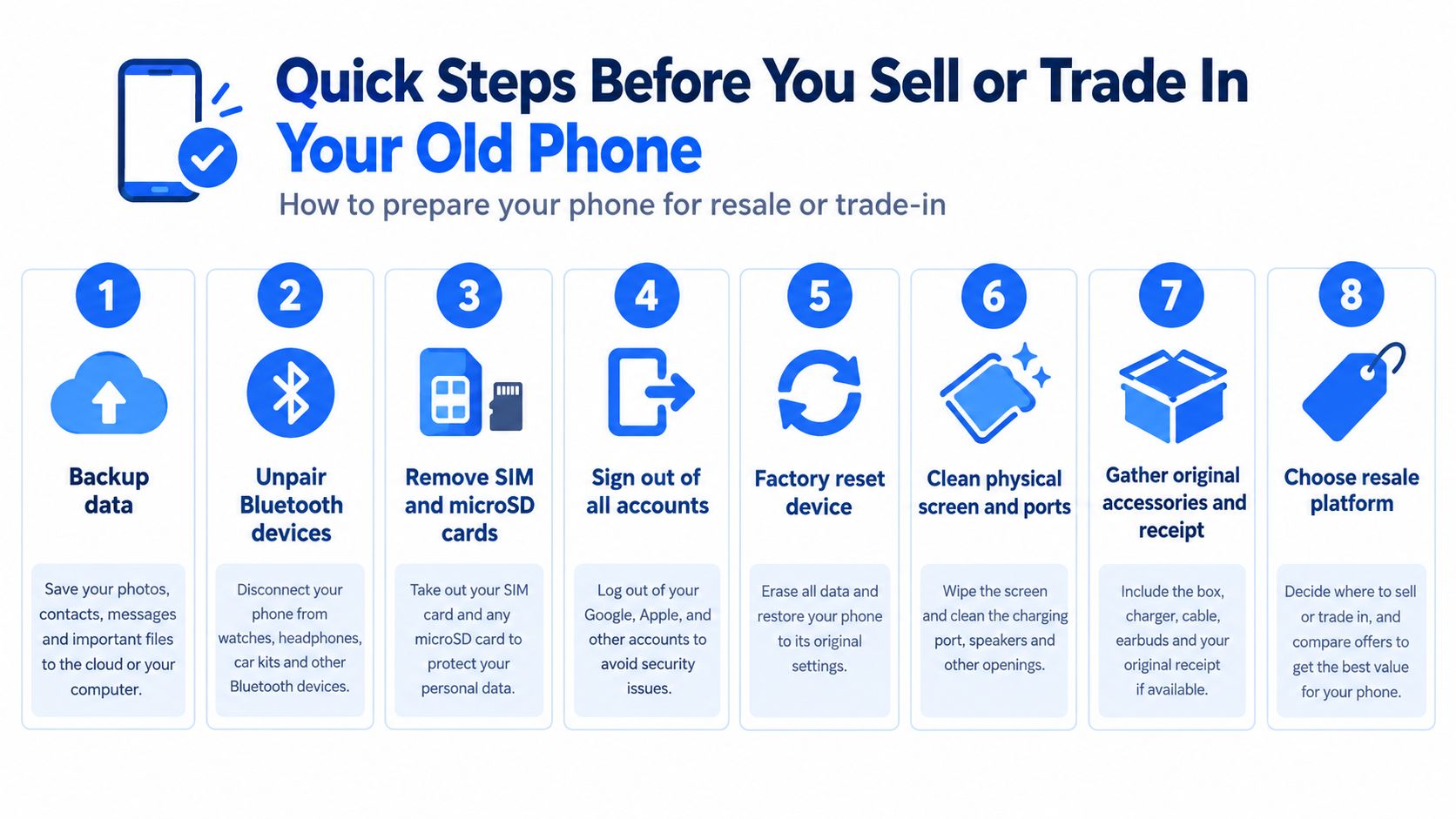
How to prepare your phone for resale or trade-in, Quick Steps
- Back up your data: Save photos, contacts and messages before you remove anything.
- Unpair Bluetooth devices: Clear watches, earbuds and car connections if they’re linked.
- Remove SIM and microSD cards: Take out anything physically stored in the phone.
- Sign out of all accounts: Leave no active cloud, email or app login behind.
- Factory reset the device: Use the manufacturer path, not a random shortcut.
- Clean the phone physically: Wipe the screen and ports so the next check is honest.
- Gather original accessories and receipt: If you still have them, they help with resale confidence.
- Choose the right resale route: Trade-in, refurbisher or private sale all ask for slightly different evidence.
Then check the listing side. A refurbisher should be able to show the IMEI, grade, battery health, network status, wipe status and warranty position without making excuses. If one of those fields is missing, the record isn’t ready yet, even if the phone is switched on and looks fine.
The Verdict Is It Worth the Effort
Yes, it’s worth it whenever a phone, its data, or the record about it is being passed to someone else. That includes selling, donating, trading in, returning for repair or handing a handset to the next owner.
People who benefit most are sellers, buyers of refurbished handsets, and small resale operations that need clean, auditable stock records. If you’re keeping the device and not handing it over, you can usually skip the deeper version of the process. If you’re comparing refurbished phones, choose the listings that show the work instead of asking you to trust a vague description.
Used Mobiles 4 U already sells tested, SIM-free, clearly graded phones with secure data wiping and warranty support, so if you want the practical route rather than doing every check yourself, that’s the sort of setup to look for. For anyone selling an old phone or buying a replacement, the main question is simple, can you prove the phone is clean and the listing is clean too?
Written by James Waterston, 24 years in the mobile phone industry from customer service through to Sales Director of a global repair and recycling company. Now running Used Mobiles 4 U for over 8 years. LinkedIn
If you need a refurbished phone, a trade-in route, or a device that’s already been tested, wiped and clearly graded, Used Mobiles 4 U handles that work before the handset reaches you. If you’re comparing used iPhones, Samsung Galaxy phones or other refurbished smartphones, visit Used Mobiles 4 U and look for the listing details that show the wipe, the grade and the battery checks.
Looking for a refurbished phone?
Shop professionally tested refurbished iPhones and Samsung phones with 18 month warranty, 30 day returns and free UK delivery.
Browse Refurbished Phones