

Refurbished vs New Phone: Which Is Better Value in 2026?

23/11/2026

13 Mins

The cheapest phone can be the more expensive one to own if it needs a battery or replacing early. For most routine replacements, a well-tested refurbished handset is better value, while new makes sense when you need unused hardware or the longest available software-support window. The refurbished vs new phone decision should start with expected ownership cost, not the price on the screen.
Compare available refurbished phones: Browse the refurbished phone shop or explore the refurbished iPhones category for current UK stock, grades and prices.
Refurbished vs New Phone Side by Side
Quick Comparison
- Choose refurbished for a lower purchase price with documented testing and clear protection.
- Choose new for unused condition, a fresh battery and the newest hardware.
- Repair first if your existing phone still meets your needs and has a straightforward fault.
These refurbished terms describe our eligible phones, not every refurbished seller. Device cover and battery cover have different durations, so read what each protects against rather than treating them as interchangeable.
A newly purchased phone isn't necessarily a newly released model. Discounted old stock can have less remaining software support than you expect, even though nobody has used it.
The same distinction between condition, reconditioning and protection matters outside phones. Value Tools Co.’s budget tool buying guide for contractors is a useful parallel when comparing used equipment descriptions, although phone-specific terms remain essential.
Use live listings rather than a general savings estimate. Your decision usually comes down to:
- Budget: What can you comfortably spend, including accessories?
- Ownership: How long must the handset remain useful?
- Condition: Would you rather pay for cleaner cosmetics or more battery capacity?
What the Price Gap Really Covers
Effective ownership cost is the purchase price plus the expenses needed to keep the phone useful. A cheap listing isn't good value if you immediately need a battery, the correct charger and a repair the seller won't handle.
In 2024, 79% of UK consumers planning to purchase a new phone said they would consider a refurbished device, with 42% citing saving money and 27% environmental benefits, in Vodafone and CCS Insight's findings. That interest makes sense, but a potential saving still needs checking against the individual handset.
Build the cost around your use
- Purchase price: Compare the same model and storage capacity, not merely the same brand.
- Battery work: Include a replacement allowance if the advertised battery condition won't suit your daily routine.
- Accessories: Check whether you need a compatible cable, charger and protective case.
- Early replacement risk: Consider what happens if a fault leaves you without a usable phone or a practical remedy.
Then spread that total across the period you realistically expect to keep it. There's little benefit in planning long ownership if the phone won't support an essential work app for that period.
Say you're choosing between matching Samsung Galaxy models. The cheaper one has unclear battery information and an imprecise condition description; the dearer one documents both. You aren't just paying extra for the same phone, you're reducing uncertainty about its next expense.
Buying rule: Compare the cost of a usable, supported phone, not the cost of getting a handset through the door.
Why matching listings have different prices
Grade, storage, battery condition and colour can all affect the asking price. Extra storage is useful if you keep lots of video locally; paying for a preferred colour is a personal choice rather than a functional upgrade.
Our clearance deals reduce the price of selected refurbished phones while stock lasts. Those devices retain the applicable warranty and returns terms shown on their product pages.
Read those terms on each listing before paying. If the cheaper phone's condition claims are vague, its apparent saving can disappear at the first repair.
What Usually Affects Value
The grade on a refurbished listing shapes the price before anything else does. These are our refurbished iPhone grades:
- Like New: Little to no visible wear, suited to buyers who want the cleanest appearance.
- Excellent: Light marks, usually visible only up close, for buyers seeking minimal wear without prioritising pristine cosmetics.
- Very Good: Noticeable marks, suited to buyers who put price ahead of appearance.
- Good: Clear wear across the body, useful for budget purchases, second phones and phones destined for a case.
Each grade describes the visible wear on the body of the phone. Our refurbished iPhone grading guide with photo examples turns those descriptions into something you can judge before paying.
A Good-grade phone shouldn't mean unreliable charging or an unusable camera.
Battery health matters more than the finish
Eligible refurbished phones from Used Mobiles 4 U are supplied with at least 85% battery health at the point of sale. The figure describes remaining capacity relative to the battery's original capacity.
A handset at that level can suit messaging, calls, browsing and photos. Heavy navigation, gaming, hotspot use or video recording may mean charging more often, so match the battery to your routine rather than looking only at the grade.
On compatible iPhones, check Settings > Battery > Battery Health and Charging. Menu wording can differ by model and software version; Android checks also differ, so use the manufacturer's battery menu or diagnostic tool for that specific handset.
Check what sits behind the listing
Every refurbished phone goes through our structured 50-step check before listing. This includes device-status checks, functional testing, secure data wiping, battery-health verification, cosmetic grading and final quality control.
Beyond that process, focus on practical compatibility:
- Storage: Choose enough space for your photos, apps and downloaded files.
- SIM-free status: Our phones are SIM-free, allowing you to choose your network rather than buy around a network restriction.
- Charging connection: An older iPhone with Lightning may suit accessories you already own; USB-C models suit newer cables and chargers.
- Mobile service: Confirm whether the exact model supports 5G or only 4G, and that it suits your network.
- Updates: Check the manufacturer's remaining iOS or Android support before committing to long ownership.
Don't assume a cosmetic upgrade improves any of these things. I'd prioritise suitable battery capacity and remaining support over a spotless back panel that will spend its life inside a case.
Warranty, Returns and Your Legal Protection
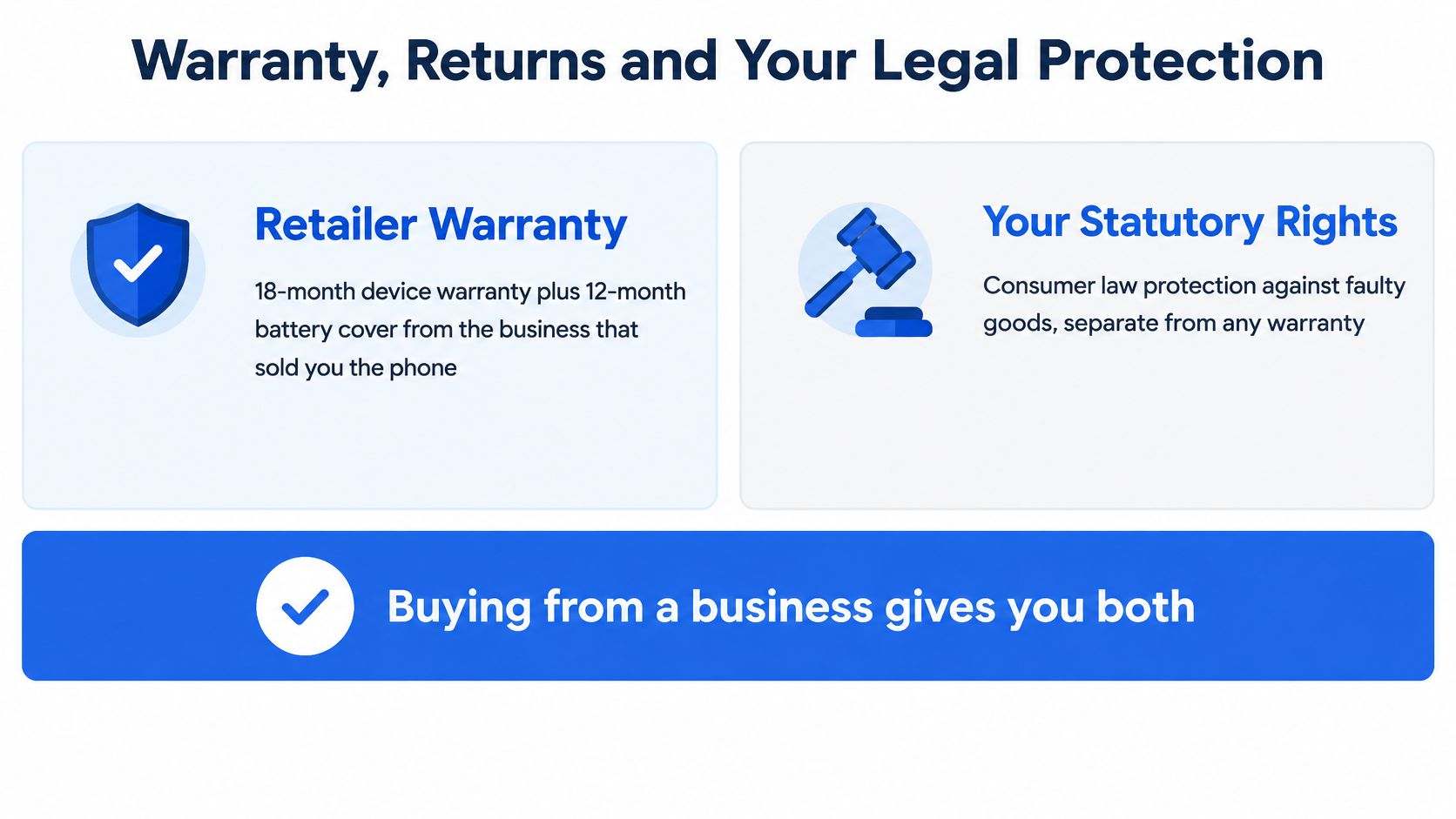
A retailer warranty and your statutory consumer rights are separate protections, and a refurbished phone bought from a business carries both. The handset having a previous owner removes none of your legal cover. Our refurbished phones come with an 18-month device warranty, and the returns terms appear on each product page; the UK refurbished-phone warranty guide explains how that cover sits alongside your legal rights.
Warranty strength feeds directly into the effective cost of ownership. Cover you can claim on is what stops a faulty unit becoming an early replacement you pay for yourself.
What consumer law protects
Under the Consumer Rights Act 2015, a refurbished handset sold by a business must be of satisfactory quality, fit for purpose, reasonably durable and as described, judged against its age, price and disclosed condition. MoneySavingExpert's refurbished-phone guidance sets out the practical sequence: a 30-day right to reject an undisclosed faulty phone, a repair-or-replacement remedy after that, and the presumption that a fault appearing within six months existed at supply unless the seller proves otherwise.
Those standards are measured against the listing itself. A cosmetic mark declared on the product page formed part of the agreed sale. The legal remedies target faults the description never disclosed, so keep a copy of the listing and its photos as a record of what you bought.
A new phone adds the manufacturer's warranty on top of the same statutory rights, but the legal floor underneath is identical either way. Even at new prices, check the seller's returns arrangements before you buy.
Test before you settle in
- Keep the paperwork: Save the order confirmation and product description.
- Confirm the cover: Read the duration, exclusions and claim procedure on the product page.
- Check the handset thoroughly: Try charging, Face ID or fingerprint recognition, cameras, calls, microphones and speakers.
- Contact support first: A fault you report straight away is a warranty claim; the same fault after an outside repair can turn into a dispute about who caused it.
A warranty is most useful when you understand how to use it before something goes wrong.
The same approach applies to other refurbished devices. If you're also considering a tablet, Tinymoose's guide to where to buy refurbished iPads safely provides a relevant checklist, but always read the actual seller's terms rather than transferring assumptions between products.
Environmental Impact and Longer Ownership
Keeping useful hardware in service is the main environmental argument for refurbished. It works best when the handset replaces a new purchase and stays in use for years, rather than becoming another short-lived upgrade.
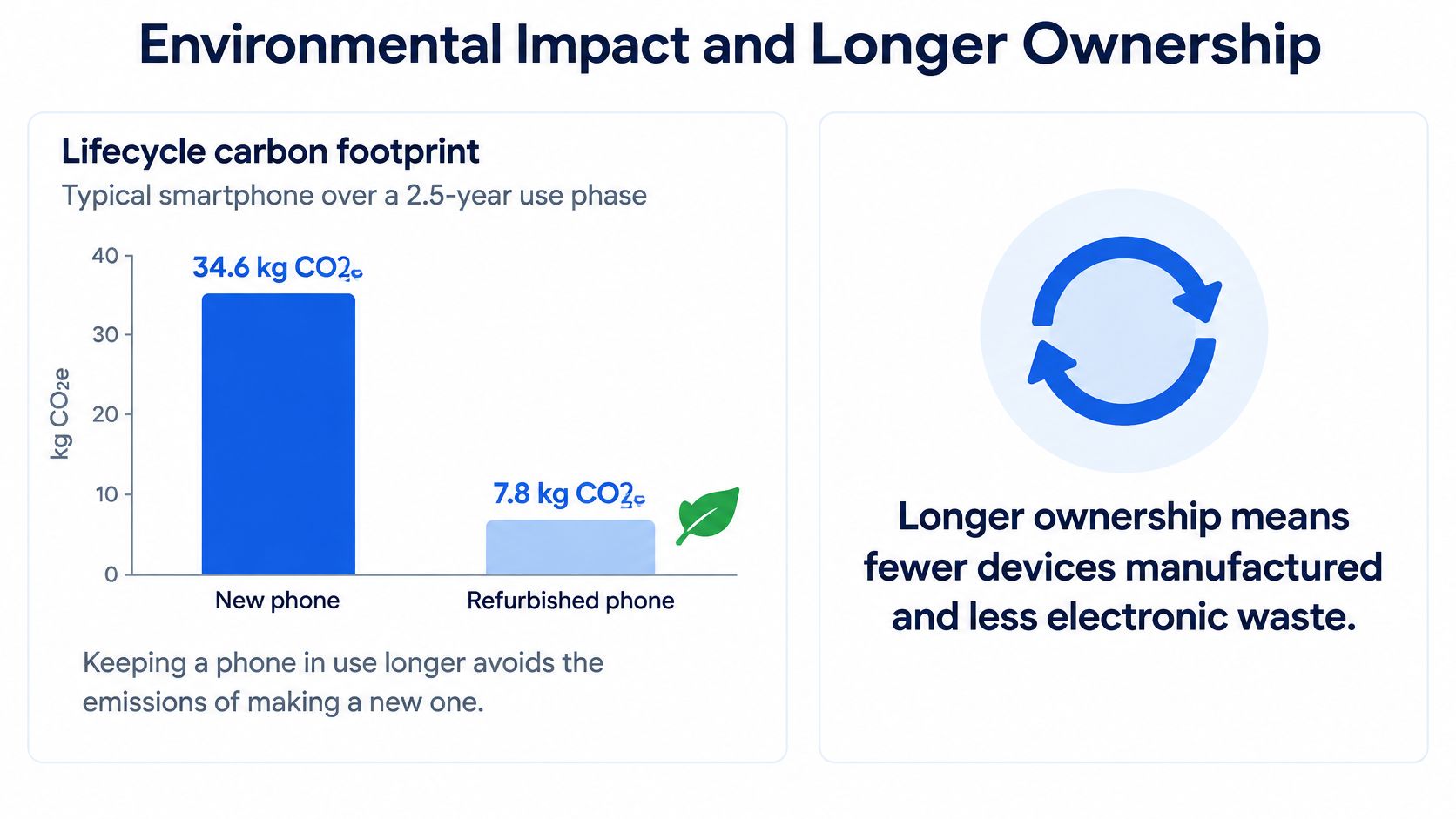
The EE Business environmental substantiation document models a typical smartphone over a 2.5-year use phase at 34.6 kg CO2e new versus 15.5 kg CO2e refurbished, approximately 55% lower for the refurbished route, and cites the Carbon Trust's illustrative estimate of around 15 kg CO2e for refurbishment activities such as inspection, repair, packaging and transport.
What makes the saving meaningful
That comparison concerns emissions, not speed or battery endurance. It doesn't prove that every refurbished unit performs identically to a new example of the same model.
Refurbishment still carries an emissions cost, which is why how long you keep the phone matters. A refurbished handset kept for three years spreads that cost thinly. One replaced after a year barely saves anything over buying new, and the same logic applies to your wallet: ownership cost drops the longer the phone serves you.
- Repair a suitable phone: A replacement battery or screen can preserve a handset that still does everything you need.
- Buy for lasting usefulness: Select enough storage and remaining software support to avoid another premature replacement.
- Pass on the old device: Sell, trade in or responsibly recycle it instead of leaving usable hardware in a drawer.
Before passing a phone on, back it up, transfer anything important, remove linked accounts and erase it using the manufacturer's reset process. Confirm the transfer worked before deleting your only copy of photos or messages.
Our approach to sustainability centres on extending device use. The practical priority is often to repair the phone you already own, then consider a refurbished replacement you'll keep, rather than upgrading because a newer model exists.
Our Experience Refurbishing This Model at Used Mobiles 4U
There isn't one model that settles this comparison. An iPhone and a Samsung Galaxy need model-specific assessment, and the condition of the individual handset matters as much as its name.
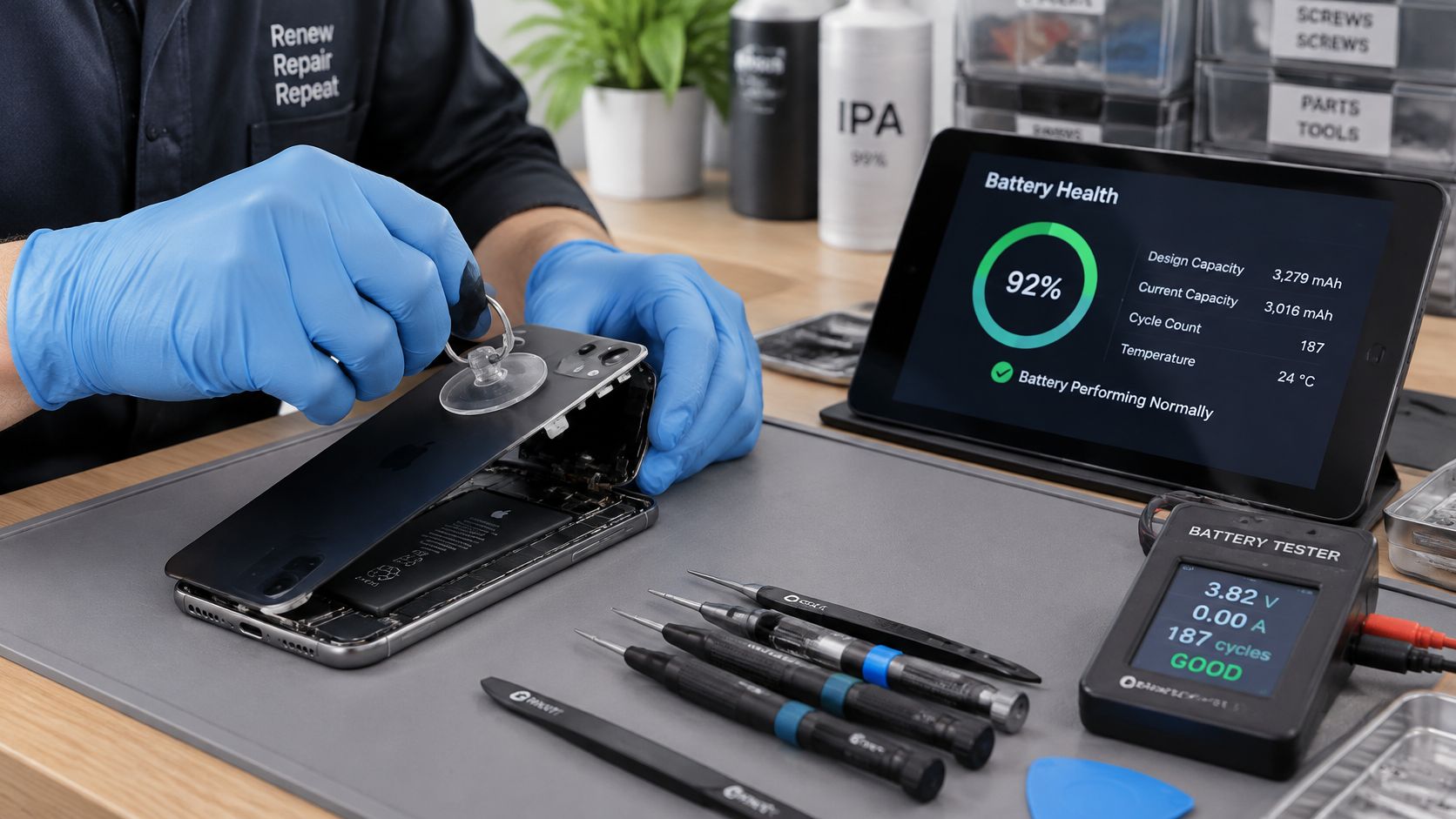
Our refurbishment process combines functional checks with battery verification and cosmetic grading. The important workshop principle is straightforward: a clean-looking phone can still have a tired battery.
Look beyond the obvious damage
Take a typical assessment scenario: a handset starts normally, its screen looks tidy and its owner reports unreliable charging. Replacing the battery immediately would be guesswork.
A technician should inspect the cable connection, check for debris or physical port damage, test with suitable charging equipment and assess battery behaviour. A plug that won't seat correctly and a battery that can't retain charge are different faults, even when the customer describes both as poor charging.
Worn edges and surface scratches help establish cosmetic condition. Cracked rear glass needs a separate safety assessment, while a scratched camera lens deserves image testing because it may affect photographs rather than merely appearance.
After a drop, test biometric recognition rather than assuming that an intact screen means Face ID or the fingerprint reader is unaffected. Listen for speaker distortion, record a voice sample and check focus across the cameras.
Bench judgement: Diagnose the fault before choosing the part. Replacing something isn't evidence that the underlying problem has been fixed.
Repair the right fault
Batteries, screens and charging ports are repair candidates, with back-glass work considered where condition or safety requires it. That isn't a promise that every refurbished phone has received those parts, nor should a buyer assume that refurbishment means every component is new.
If the battery is the only problem, the handset passes its other checks and software support remains suitable, repair is usually the sensible starting point. Logic-board faults, camera damage and liquid exposure require a fuller estimate before deciding.
Replacement becomes more persuasive when several faults overlap or repair would leave you with an ageing, poorly supported device. Water damage especially calls for caution because making a phone switch on isn't the same as establishing dependable operation.
Compare nearby options carefully
An older flagship can be worth considering against a newer budget model if camera quality and demanding apps matter. Don't infer performance from cosmetic grade, and don't assume the flagship wins without checking its battery and support.
For a concrete listing example, the iPhone 12 Pro – Gold – 128GB – Like New is a refurbished, fully tested handset supplied SIM-free and ready for use on UK networks. Its appearance grade doesn't remove the need to assess whether the model suits your intended ownership period.
Our refurbishment process uses Mobicode, with 50+ device checks available across testing, alongside:
- Device status: Checks before the phone is prepared for resale.
- Functionality: Assessment of charging, cameras, audio, connectivity and other device functions.
- Battery verification: Condition checked rather than inferred from appearance.
- Data preparation: Secure wiping before resale.
- Final assessment: Cosmetic grading and quality control before listing.
Who Should Buy Refurbished and Who Should Buy New
A parent choosing a first or replacement phone for a child faces a simple test. Does the handset run the required apps, last through the expected day and come with a clear route to help if something fails? Those questions decide the purchase. The age of the chip inside rarely does.
A tested refurbished handset is usually the sensible choice for that situation. Money spent on pristine cosmetics often buys less than appropriate storage, a protective case and a model with suitable remaining support.
Choose a refurbished phone if
- Your budget has a firm limit: You want the most suitable handset within it, and paying for unused condition would cut into the storage or accessories you need.
- You're comfortable with disclosed wear: A marked casing won't bother you once the phone is in a case.
- You want documented preparation: Professional testing, secure data wiping and a clear grade matter more than an informal private-sale description.
- You prefer to extend product life: You intend to keep useful hardware working instead of replacing it early.
- You need network flexibility: A SIM-free phone lets you choose a suitable UK network and plan.
Students, parents and budget-conscious buyers fit this route well. So do environmentally minded buyers who pick a supported device and keep it for years.
Small businesses should look beyond the cheapest individual handset. Matching models, storage and support requirements simplifies staff setup and replacement planning, while inconsistent bargain purchases create extra administration. Corporate buyers can request a quote by stating the number of handsets required and the manufacturer: iPhone, Samsung, Motorola, Lenovo or another brand.
Choose a new phone if
- You need specific new hardware: Your work or daily use requires a feature only the current generation offers.
- Battery demands are unusually heavy: You want a fresh battery and would rather not assess previous wear.
- You plan extended ownership: The latest model's longer remaining support window justifies the extra cost across the years you intend to keep it.
- Unused condition matters: You won't be satisfied with any cosmetic history, even clearly disclosed marks.
Don't buy an old-stock new phone solely because the box is sealed. Check the release generation and support position, particularly for an Android handset intended for work.
The same caution applies to refurbished stock. Skip any seller whose condition descriptions or remedies are unclear, because a low price doesn't compensate for a purchase you can't assess properly.
The recommendation
For most UK buyers replacing a phone, I'd start with refurbished, provided the battery condition, grade and warranty are clear. Run the same test as the parent above: required apps, daily battery life, remaining support and a remedy if something fails. If your current handset still works well, keeping it costs less than replacing it just to obtain a refurbished deal.
The logic of paying for capability over a new-condition premium appears across pre-owned markets. ECI Jewelers' luxury watch depreciation explained offers a parallel discussion of how new and pre-owned value diverge.
Our range includes professionally tested, SIM-free iPhones, Samsung Galaxy phones and Motorola devices, with UK-based support for post-purchase help. Compare the exact listing with your daily requirements, and judge the refurbished vs new phone decision on useful years ahead, warranty cover and battery health. The lowest checkout total can hide a shorter remaining life.
Old phones can also be traded in through Sell Your Tech. Back up and transfer your information before preparing a device to leave your ownership.
Written by James Waterston. Connect with James on LinkedIn.
Used Mobiles 4 U offers professionally tested, SIM-free refurbished iPhones, Samsung Galaxy phones and Motorola devices with clear grading and UK support. Visit Used Mobiles 4 U to compare listings, check battery health and cover, or contact the team with the model you're considering before you buy.
Looking for a refurbished phone?
Shop professionally tested refurbished iPhones and Samsung phones with 18 month warranty, 30 day returns and free UK delivery.
Browse Refurbished Phones