


Are Batteries Covered Under Warranty? UK Guide

24/10/2026

11 Mins

Yes, batteries can be covered under warranty for manufacturing defects, failure to meet an advertised battery-health standard, or faults that make the device unusable. Ordinary capacity loss is usually excluded, while your rights under the Consumer Rights Act 2015 sit separately from any commercial warranty.
But when a seller says the battery is covered, do they mean its condition when it arrives, a later fault, or how long it lasts between charges? Those are different promises, and the distinction matters when you need help.
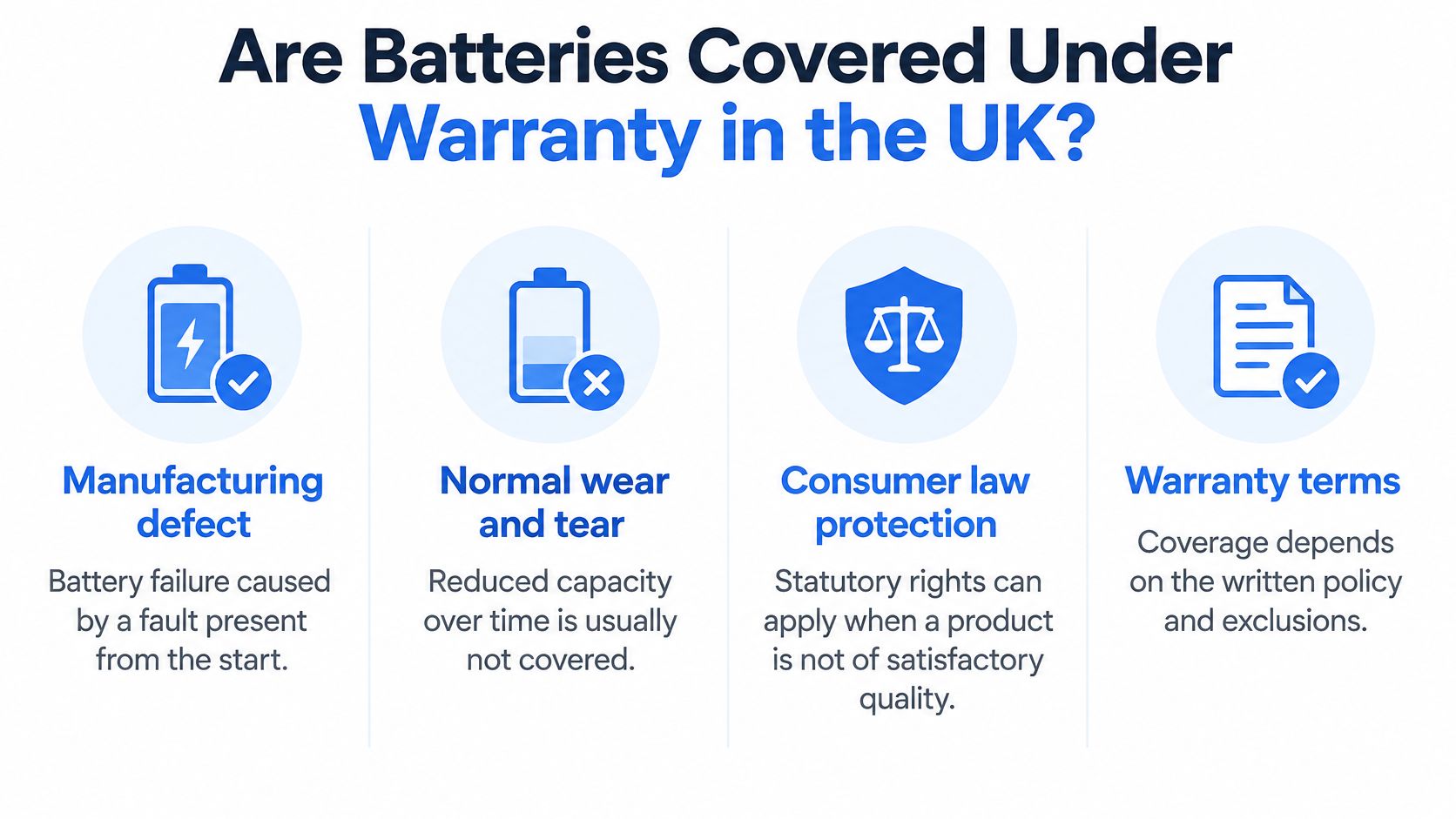
Are Batteries Covered Under Warranty in the UK
A battery isn't automatically excluded from protection just because it's a consumable component. What matters is what has gone wrong, when it happened, and what the seller promised.
The Short Version
- Defective battery: Failure to charge, swelling or abnormal shutdowns may support a claim.
- Normal ageing: Gradually shorter battery life isn't automatically a covered fault.
- Below the advertised standard: A battery that arrives below the seller's stated condition may mean the phone wasn't as described.
- Written terms: Check battery-specific cover, not just the headline handset warranty.
The Consumer Rights Act guidance explains the underlying standard: goods must be of satisfactory quality, fit for purpose and as described. For a used phone, the assessment takes account of its age, price, condition and description.
Identify the promise that hasn't been met
Start with the listing rather than your memory of how long your previous phone lasted. Did the seller state a minimum battery-health figure? Was that a dispatch standard, or a promise to maintain that figure throughout the warranty?
Next, describe the symptom accurately. A handset that won't retain charge presents a different question from one that needs charging earlier after prolonged use. Neither a battery-health screenshot nor a complaint about poor runtime tells the whole story on its own.
A useful distinction is between condition at delivery and performance during ownership. If the phone arrived below its advertised standard, your complaint concerns what you were supplied. If it worked properly and later developed a fault, the timing, diagnosis and applicable cover become important.
Practical rule: Tell the retailer what the phone does, when the problem started and which advertised promise you believe it hasn't met.
That approach is more useful than asking for a new battery. It gives the seller something specific to investigate and keeps the discussion focused on the right remedy.
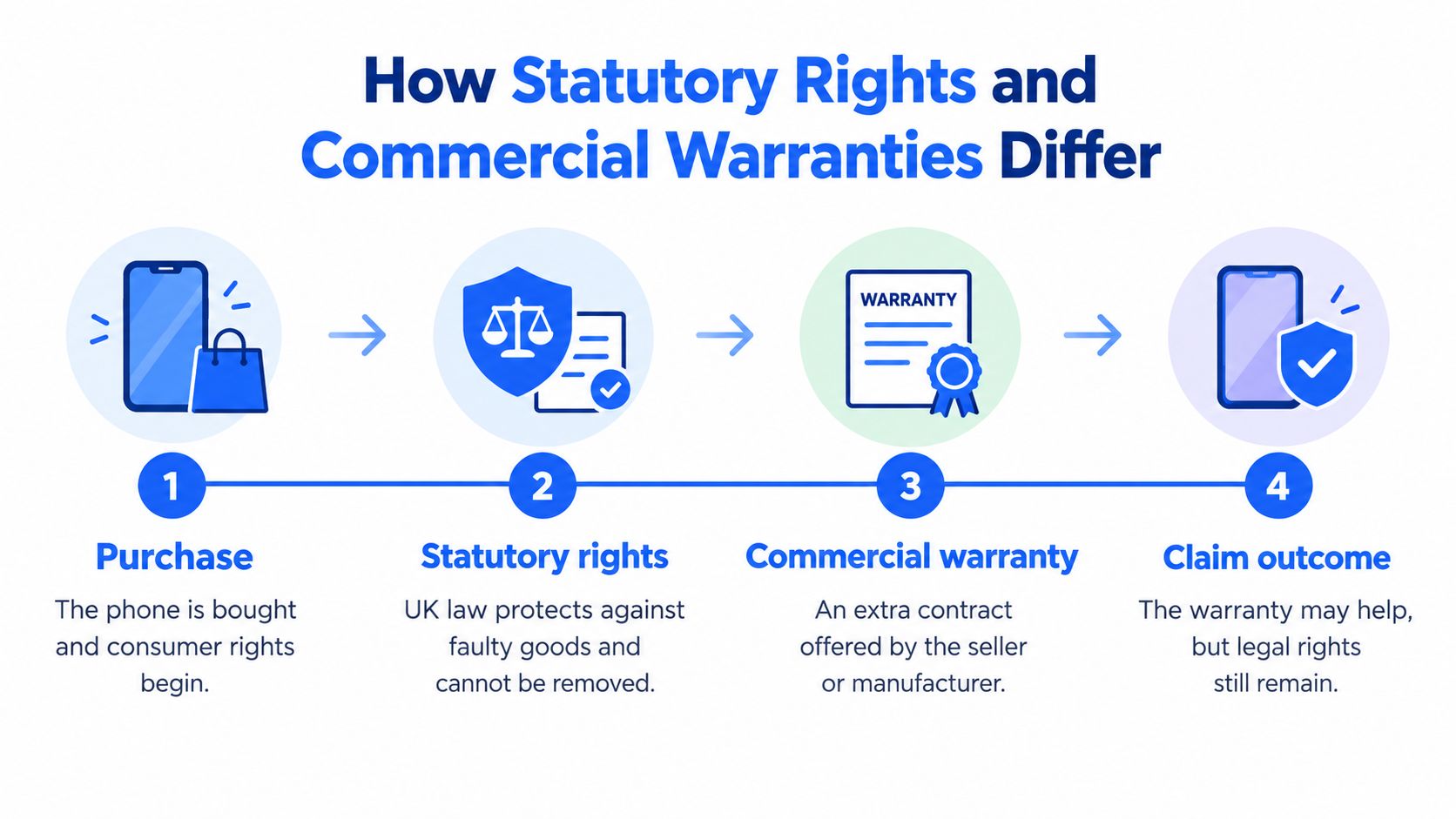
How Statutory Rights and Commercial Warranties Differ
A commercial warranty is an additional agreement. It can define covered faults, exclusions and claim procedures, but it doesn't replace your rights against the retailer that sold you the phone.
An expired manufacturer warranty isn't, by itself, a complete answer to a statutory complaint. Equally, statutory rights aren't an unconditional promise that every ageing battery will receive a free replacement. When a customer brings a phone back to me, the first question is which of the three it is: a defective cell, normal chemical ageing, or a handset that arrived below the standard the listing stated. Each one takes a different route, and the law treats them differently too.
The important claim stages
- Within 30 days: You can generally reject faulty goods for a refund under the Consumer Rights Act remedy framework.
- During the first six months: Faults are generally presumed to have been present at delivery unless the retailer shows otherwise. Repair or replacement will normally be the relevant route under that same guidance.
- After six months: Keep a dated diagnostic report or an independent test result showing the fault was already present at delivery, because the retailer can otherwise attribute it to use.
- Longer-term claims: Claims can be brought for up to six years in England and Wales, or five years in Scotland, where the goods could reasonably have been expected to last that long, as explained in government guidance on warranties and consumer rights.
Those longer periods are not battery-life guarantees. They don't establish that a particular battery should retain its original capacity throughout that time.
What the retailer must do
For a qualifying statutory repair or replacement, the trader must act within a reasonable time, avoid significant inconvenience and bear necessary costs, including labour, materials and postage. Those obligations are set out in section 23 of the Consumer Rights Act.
Keep your purchase confirmation, the original listing, dated battery-health evidence and any diagnostic report. Together, they help establish what was promised and whether the phone met that promise.
For the retailer's commercial terms, check the refurbished-phone warranty information separately. Don't assume a device warranty and a battery warranty necessarily have identical durations or exclusions.
The practical trade-off is straightforward: a commercial warranty may offer a convenient claim route, while a statutory claim can require a closer assessment of the phone's condition and history. Pick the route that fits the fault you have, and bring the evidence to support it.
What Apple, Samsung and Refurbished Retailers Actually Cover
The name on the handset doesn't tell you everything about battery cover. Manufacturer protection and the refurbished seller's own promises need checking separately.
Battery cover by provider
- Apple: Its UK limited warranty covers manufacturing defects for one year, but excludes batteries worn through normal use and accidental damage. Apple's battery-service information also identifies below 80% capacity as a threshold for no-charge replacement under eligible cover. Check the applicable service terms rather than treating that percentage as an automatic entitlement for every used iPhone: Apple iPhone battery service.
- Samsung: Its UK information lists a 12-month battery warranty, while also stating that a device with a battery issue that is less than 24 months old will be deemed in warranty. Proof of purchase and a complete, undamaged serial number matter. Because those statements sit alongside each other, ask Samsung to confirm eligibility for your handset: Samsung UK warranty status.
- Refurbished retailers: Look for a stated battery condition at sale, a defined battery-cover period and clear exclusions. There's no universal refurbished battery warranty, so the individual seller's terms matter.
For Samsung buyers, the guide to warranty on Samsung phones is a useful starting point for separating retailer cover from manufacturer protection.
Choose condition and cover before chasing specifications
A newer model isn't automatically the better purchase if its battery condition or support arrangements are unclear. If you're choosing between Galaxy A27 and A37, keep the model comparison separate from the seller's battery promise. A comparison can help narrow your shortlist, but it can't establish what a particular refurbished listing includes.
For an iPhone example, the iPhone 15 Plus – Black – 128GB – Like New listing specifies a fully tested, SIM-free refurbished handset with 85%+ battery health, an 18-month warranty and 30-day returns. The important distinction is that its stated battery condition and its device-warranty duration describe different things.
Don't read “Like New” as a promise of a newly manufactured battery. Ask what the cosmetic grade means and what battery standard applies independently.
Our recommendation: prioritise a measurable condition standard and an understandable claim process over a vague promise of broad cover. That's useful protection whether you're buying an iPhone, Samsung Galaxy or another Android handset.
How to Make a Battery Warranty Claim
A successful claim starts with a clear symptom, not a guess about which part needs replacing. Poor charging can involve the battery, charging equipment, the port or software, so diagnosis matters.
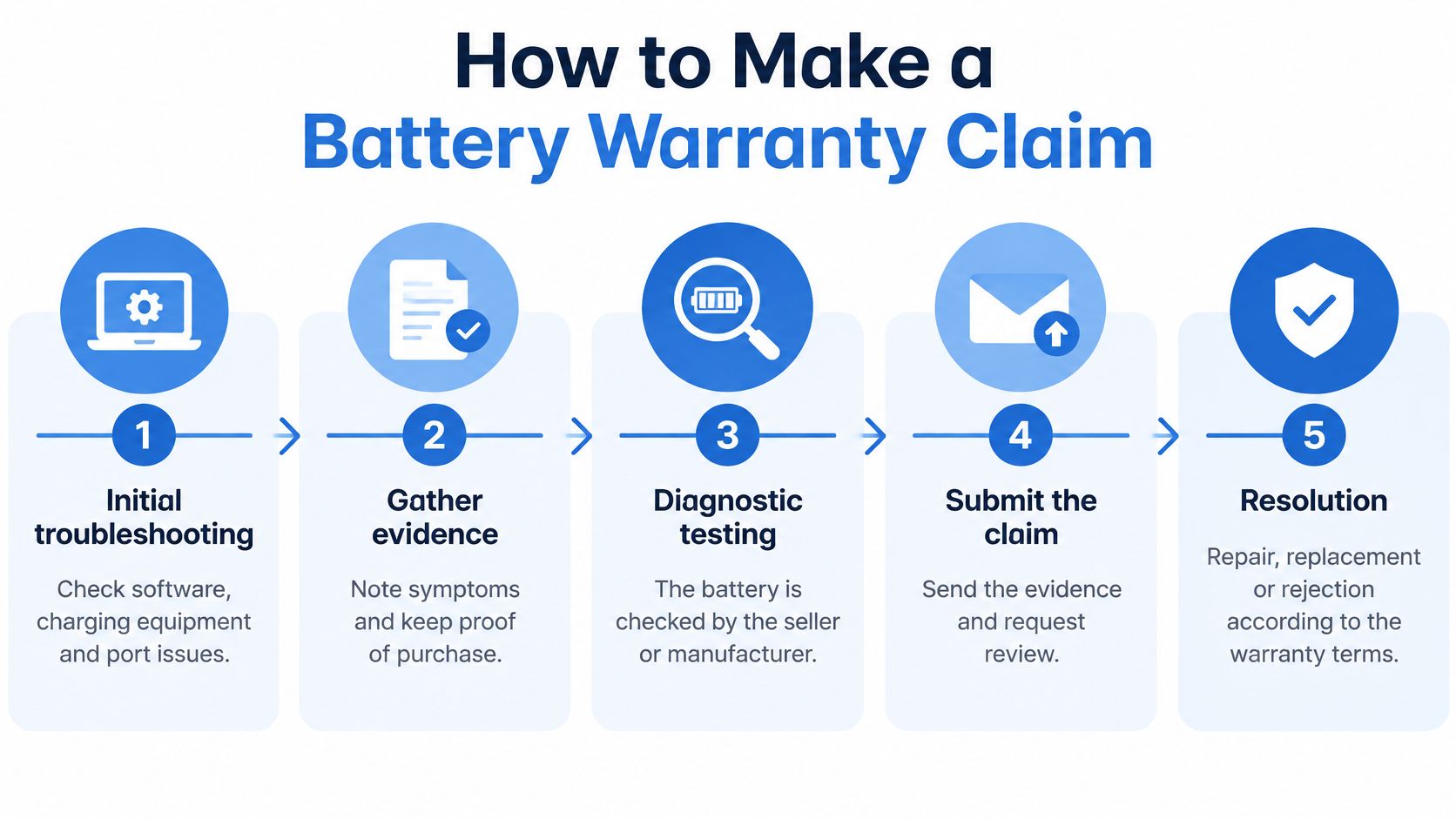
How to make a battery warranty claim in quick steps
- Check for a safety problem first. If the battery is swollen, overheating abnormally or physically compromised, stop ordinary troubleshooting and contact the retailer for safe handling instructions.
- Record the symptoms. Note when shutdowns happen, whether charging starts and stops, and whether the issue occurs with different charging equipment. Don't dismantle the handset to investigate.
- Save your evidence. Keep the receipt, listing, battery-health screenshots and any diagnostic records. Disclose accidental damage or previous repairs rather than leaving the technician to discover them.
- Contact the seller before paying for repair. Use the warranty claims and repairs pathway and explain whether you're raising a warranty claim or a complaint about the supplied condition.
- Agree the return arrangements. Ask who supplies the postage label, what happens if no covered fault is found, and how long assessment is expected to take.
- Back up before sending the phone. Ask whether testing or repair could erase data. Don't assume your photos, messages or authenticator access will remain available.
- Get the outcome in writing. Request the diagnosis, the proposed remedy and confirmation of the cover remaining afterwards.
Can you demand a battery replacement?
You can explain the remedy you're seeking, but don't assume the retailer must replace a particular component without examining the phone. The assessment needs to establish whether the battery is responsible and which remedy is appropriate.
After the initial rejection period, repair or replacement generally comes first. If that fails or can't be provided appropriately, a price reduction or rejection may become available, as outlined in Coventry Trading Standards consumer advice.
A replacement battery isn't a complete resolution unless the phone has also been checked for the problem that brought it in.
Before accepting the repaired handset, ask whether the original warranty continues, whether the replacement part has separate cover, and which date applies. Don't assume the entire warranty restarts. That needs confirming from the relevant terms, while your statutory rights remain separate.
Why Battery Covered Does Not Mean Battery Life Guaranteed
“Battery covered” sounds reassuring, but it doesn't say how long the phone should last between charges. Nor does it establish whether the seller is promising a particular battery condition throughout ownership.
A useful battery promise needs a measurement, an assessment date and a defined remedy. Without those, a health threshold can create disagreement rather than resolve it.
Capacity and daily runtime answer different questions
Battery health concerns the battery's condition relative to its original capacity. Daily runtime concerns how long your phone lasts with your use. Don't treat either as a complete diagnosis on its own.
Apple's design expectations illustrate why model context matters. Under ideal conditions, batteries in iPhone 14 models and earlier are designed to retain 80% capacity after 500 complete charge cycles, while iPhone 15 models are designed to retain 80% after 1,000 complete cycles, as detailed in Apple's battery service guidance. These are design expectations, not a blanket promise of free replacement whenever a reading changes.
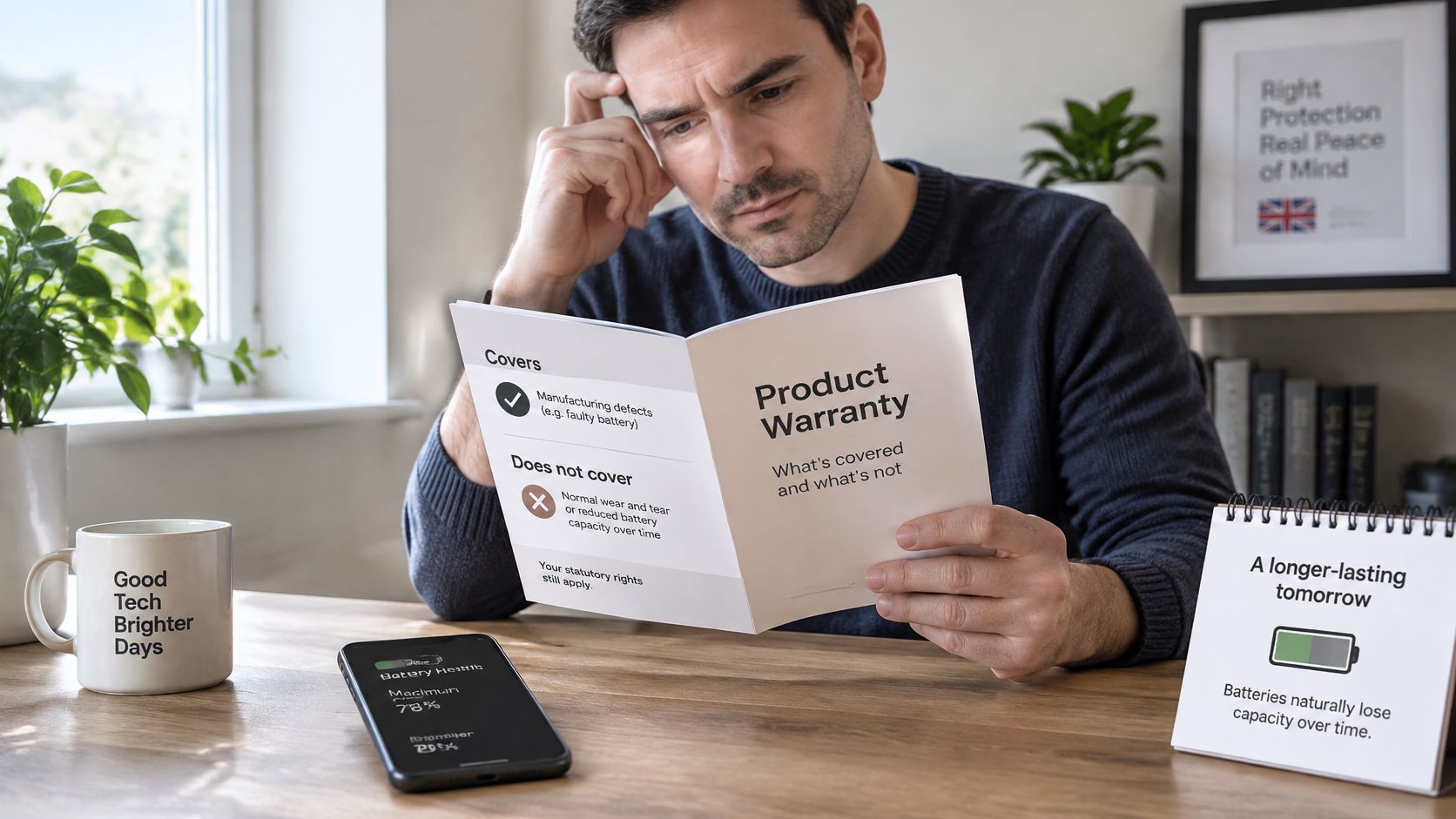
Use the guide to judging refurbished iPhone battery health to put the reading into context. The useful question isn't whether the number has fallen, but whether the condition and behaviour match what you were sold.
A realistic example
Consider a customer whose used phone needs charging earlier than expected. If it arrived below the advertised battery standard, the listing is central to the complaint. If it met that standard and has gradually lost capacity during ownership, the assessment is different.
Now change the symptom: the phone suddenly shuts down despite showing charge. That warrants diagnosis rather than an immediate assumption that the battery has merely aged.
- Sudden change: Record it and request assessment.
- Poor condition on arrival: Compare the evidence with the listing.
- Gradual deterioration: Check the wear exclusions before expecting a warranty remedy.
Safety doesn't belong in the ordinary wear category. UK consumer guidance highlights battery and product-safety considerations, and a retailer should isolate compromised units rather than continue routine testing, as discussed in Which?'s refurbished-phone buying guidance.
Our Experience Refurbishing This Model at Used Mobiles 4 U
On the bench, a battery that reads 85% can still fail a charging test, so we treat the reading as the start of the check, not the result. That holds whether the handset is a Samsung Galaxy, an iPhone or another Android phone.
Our 50-step check records battery health, then runs a charging test under load before the handset is graded. Devices that need repair are repaired and retested, or removed from sale if they don't meet the required standard.
What the bench assessment needs to establish
Charge retention, behaviour under load, physical condition, unusual heat and the charging connection all matter when assessing a complaint. A healthy reading on paper means little if the phone cuts out the moment you put it under real demand.
The repair decision should follow the evidence. Replacing a battery won't address a charging-port fault, and replacing a port won't resolve a defective battery. Where a wider fault makes a dependable repair doubtful, a replacement handset is often the more sensible route.
Bench judgement: Replace the part that testing identifies as faulty, then retest the handset. Don't use parts replacement as a substitute for diagnosis.
Cosmetic condition also needs separating from electrical condition. Marks on a housing describe appearance, but they don't establish remaining battery capacity. An immaculate exterior doesn't prove a lightly used battery either.
What We Check Before Resale
- Battery condition: Verify that the handset meets the applicable sale standard, rather than relying on its cosmetic grade.
- Charging behaviour: Check the charging connection and investigate inconsistent charging before blaming the battery.
- Physical warning signs: Look for swelling, damage and other reasons to remove a handset from normal processing.
- Whole-device function: If the charging port fails under a fresh battery, the fault is in the port, not the cell.
For eligible phones, our published standards distinguish at least 85% battery health at sale, an 18-month device warranty and 12-month battery cover. Those are separate commitments, which buyers can check against the published warranty terms, as noted earlier.
When comparing nearby models, apply the same discipline. A cheaper handset with a tired battery may need attention sooner, while a higher cosmetic grade offers little benefit if your priority is practical daily use. Choose the condition, battery standard and support arrangements that suit how you'll use the phone, not just the tidiest casing.
The Verdict on Battery Warranty Claims
So, are batteries covered under warranty? Yes, when the fault and the applicable terms support the claim, but not because the battery no longer feels new.
Most of the disputes I see come down to confusing three separate situations: a battery with a genuine defect, one that has aged through use, and a handset that arrived below the standard the seller advertised. Only the first and third justify a claim. Pursue an assessment when the phone arrives below its stated battery standard, develops an abrupt charging problem or becomes unusable. When you write to the retailer, lead with the supplied condition and the date you first noticed the symptom.
Repair or replace?
- Repair suits you if: The handset otherwise meets your needs and diagnosis identifies a repairable battery or charging fault.
- Replacement suits you if: The phone has wider problems or a dependable repair isn't practical.
- Avoid an unnecessary dispute if: Your only complaint is gradual loss of capacity after prolonged use, with no unmet description or abnormal fault.
Don't replace an otherwise suitable phone solely because its battery has aged. Equally, don't pay for a battery replacement before asking whether the problem qualifies for cover.
One point buyers overlook is what a remedy does to the cover that remains. A repaired or replaced battery can carry different terms from the original device warranty, so get the position confirmed in writing before you agree to the work.
The best next step is modest: record the current battery condition, find the original listing and send the retailer a clear description. Ask what will be tested and what remedy may follow.
About the Author
Written by James Waterston. 24 years in the mobile phone industry from customer service through to Sales Director of a global repair and recycling company. Now running Used Mobiles 4U for over 8 years. Connect with James on LinkedIn.
Used Mobiles 4 U offers tested, SIM-free refurbished phones with clear grading, defined battery standards and UK support. Visit Used Mobiles 4 U to compare suitable replacements, or contact the team with your order details and battery evidence before deciding whether to repair or replace.
Looking for a refurbished phone?
Shop professionally tested refurbished iPhones and Samsung phones with 18 month warranty, 30 day returns and free UK delivery.
Browse Refurbished Phones