


Refurbished Mobiles Means: A Plain English Explainer

04/10/2026

12 Mins
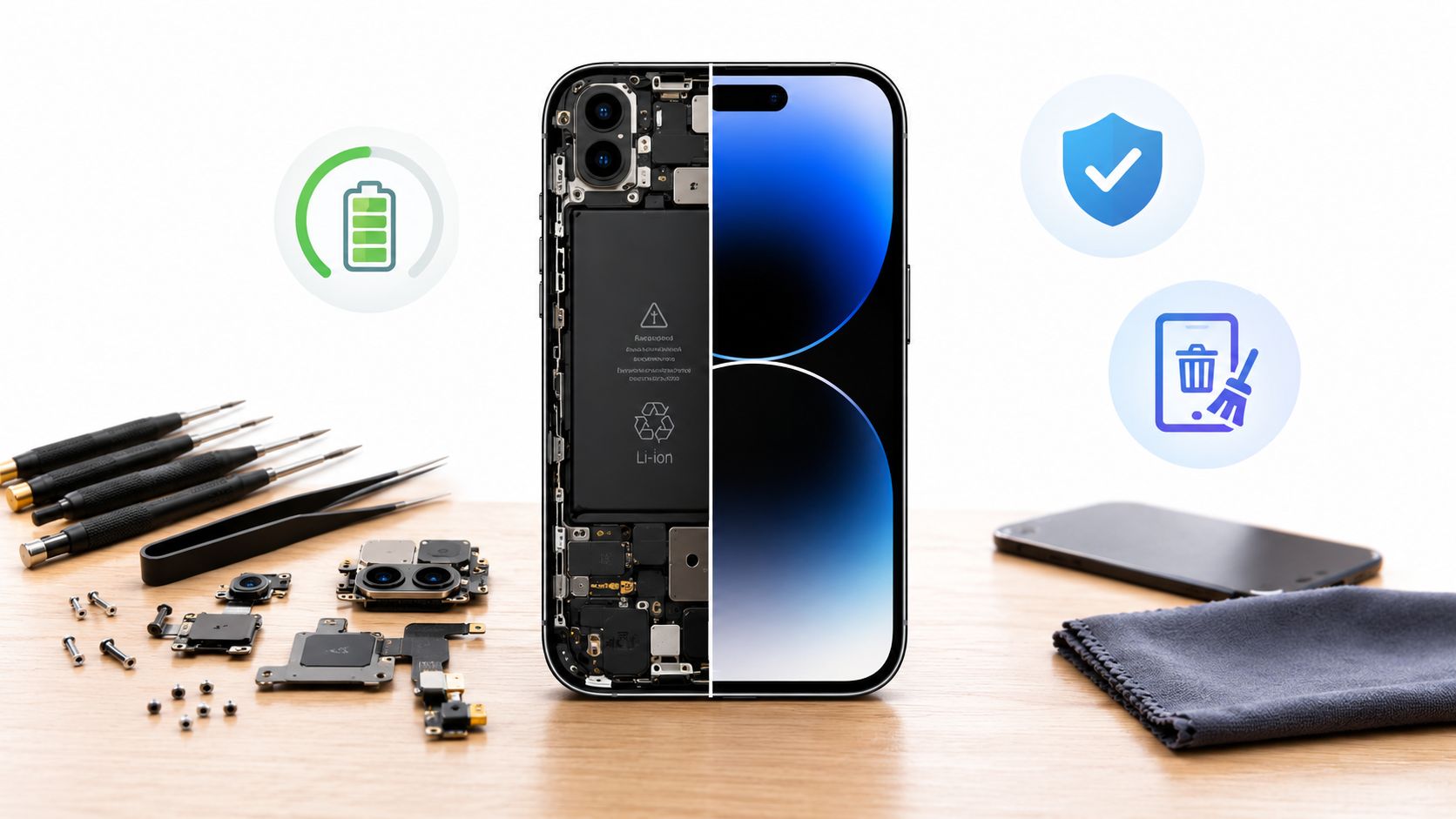
You're looking at a cheaper phone online and wondering what “refurbished” really covers. In plain English, it's a pre-owned handset that has been inspected, tested, cleaned, data-wiped and prepared for resale, with any necessary repairs completed first. The important question isn't just whether a phone is called refurbished, but what the retailer does before listing it.
What Refurbished Mobiles Actually Means
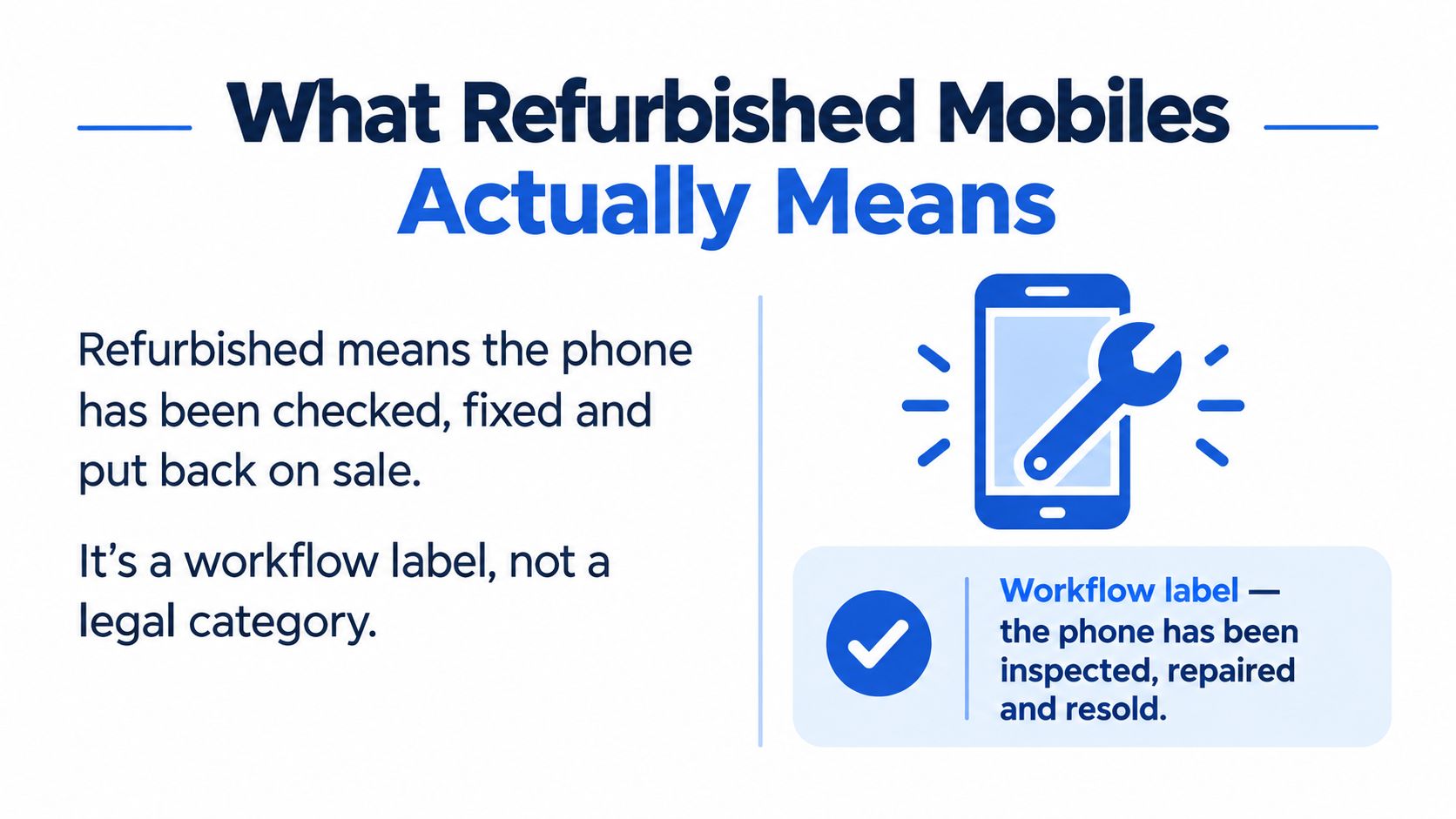
Refurbished mobiles means phones that have already had an owner, but have gone through a professional process before being sold again. A technician checks the handset, repairs faults where appropriate, removes the previous owner's data, assesses its cosmetic condition and confirms that it's ready for normal use.
The word refurbished is a workflow label, not a legal category. It doesn't automatically tell you the battery condition, the quality of replacement parts or the level of cosmetic wear. Those details come from the seller's grading policy, testing standard, warranty and product description.
Practical Verdict
- Tested device: The screen, cameras, charging, speakers, microphones, buttons, sensors and network connections should have been checked.
- Clear cosmetic grade: You should know whether to expect a near-mint handset, light marks or heavier signs of use.
- Securely wiped storage: The previous owner’s accounts and personal information should be removed before resale.
- Known battery condition: The listing should explain the battery-health standard or cover provided.
- Written protection: A proper retailer should provide clear warranty and returns information alongside your statutory rights.
The distinction matters because a private seller can describe a phone as “hardly used” without carrying out any meaningful inspection. A professional refurbisher should be able to explain what was tested, what was repaired and what condition the buyer should expect.
The market is no longer a small corner of mobile retail. NielsenIQ reported that 25% of all mobile phones sold in the UK in 2023 were second-hand or refurbished, compared with 19% in 2021. That shift shows that refurbished mobiles are now a mainstream route to a SIM-free iPhone, Samsung Galaxy or other Android handset, rather than just a way to buy an old phone cheaply. NielsenIQ's UK mobile market figures provide useful context, but the label still needs checking seller by seller.
How a Phone Gets Refurbished in the UK
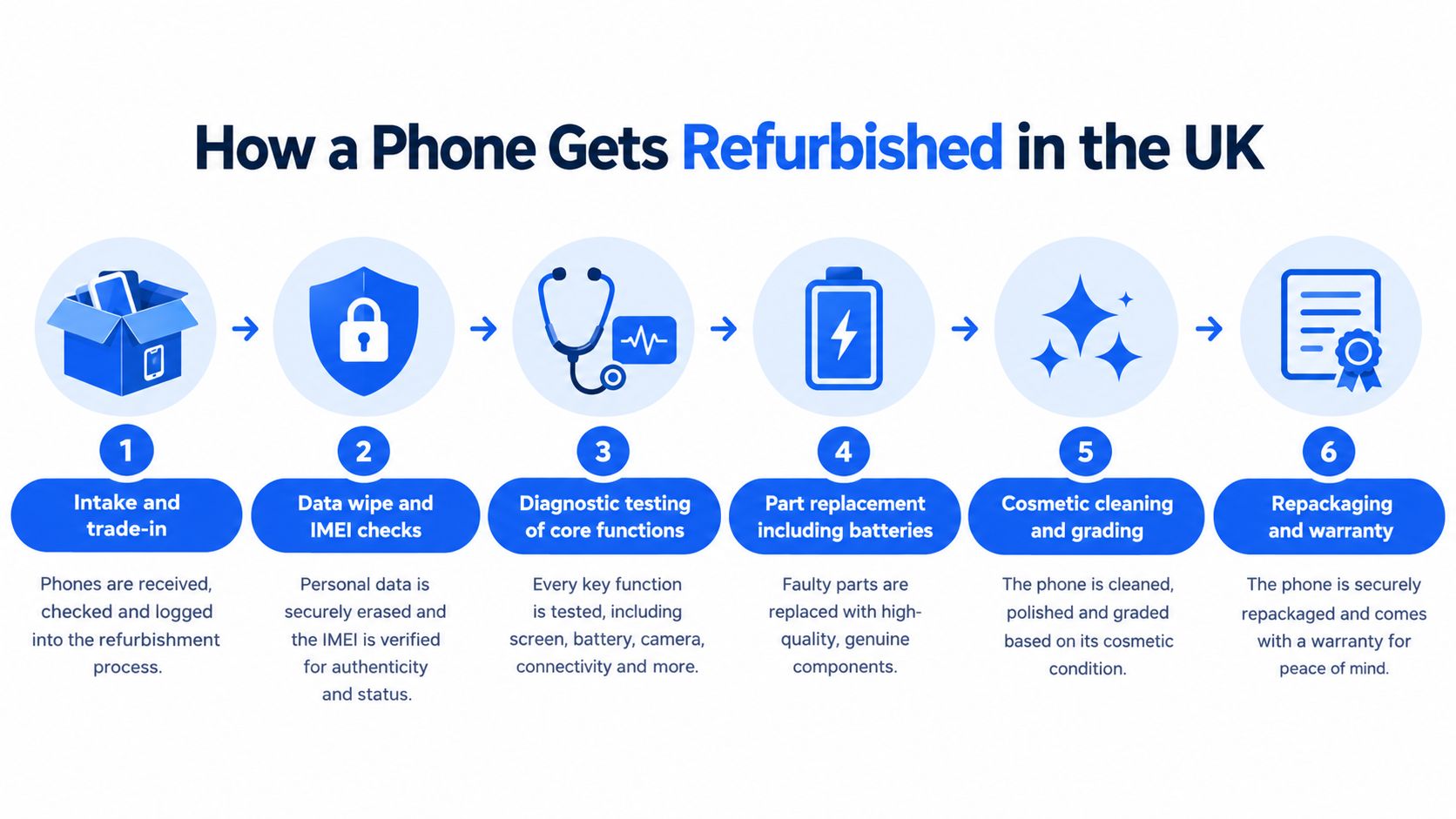
A reliable refurbishment process starts before the phone reaches the repair bench. It should follow a controlled sequence, because skipping one stage can leave a handset with a hidden fault or someone else's data.
From intake to diagnosis
-
Intake and trade-in
The phone arrives through a trade-in, buyback, recycling partner or customer return. The technician records the model, storage, colour and visible condition, then checks for signs of impact, liquid exposure or unauthorised modification. -
Data wipe and IMEI checks
The handset is checked to ensure it isn't blocked, reported lost or tied to an account that prevents activation. The previous user's data is securely removed, followed by a reset and activation check. The National Cyber Security Centre guidance on second-hand devices supports the basic rule that a used phone should be wiped or factory reset before a new owner sets it up. -
Diagnostic testing
The technician checks the display and touch response, cameras, flash, speakers, microphones, buttons, vibration, proximity and light sensors, Wi-Fi, Bluetooth, mobile signal, charging port and biometric functions such as Face ID or fingerprint recognition where fitted. -
Battery measurement
Battery health is recorded rather than guessed from how quickly the phone switched on. Major UK retailers commonly use 80% battery health as a minimum, while some use 85% as a stricter floor. O2's explanation of Like New phones describes the practical significance of that threshold, a battery at 80% retains about four-fifths of its original charge storage, but may not last like a new one. -
Inspection and repair
A failing battery, cracked screen, damaged housing or unreliable charging port may be replaced. The technician then repeats the relevant tests, because replacing one component can expose another issue or affect a seal, sensor or connection. -
Cleaning, grading and final quality control
The handset is cleaned, photographed or assessed against the retailer's cosmetic scale, repackaged and checked again before it's listed. A retailer's documented refurbishment process should make these stages understandable rather than leaving the buyer with a vague “fully tested” promise.
This is why refurbishment is more than a wipe and a polish. A phone can look excellent while having a weak charging port, a poor microphone or a battery that drops rapidly under normal use. Those are workshop problems, not cosmetic ones, so they need separate tests.
Refurbished vs Used vs New
The three choices can look similar in a search result, but they carry different levels of certainty.
Refurbished
- Warranty source: Usually supplied by the retailer or refurbisher, with the exact length and exclusions set out in writing.
- Battery: A reputable seller should state the minimum battery-health standard or explain the battery cover.
- Price: Usually below the equivalent new phone, although the saving varies with model, storage, grade and availability.
- Software: The phone keeps whatever iOS or Android support remains for that model. Buying refurbished doesn’t extend the manufacturer’s update window.
- Returns and rights: A retailer sale is covered by the Consumer Rights Act 2015. Which explains that buyers can reject a phone within the first 30 days if it isn’t as described, fit for purpose or of satisfactory quality. [Which’s second-hand phone guidance](https://www.which.co.uk/reviews/mobile-phones/article/how-to-buy-a-second-hand-or-refurbished-mobile-phone-aMG1q8n2sQPt) is a useful reference.
- Risk: Lower than a casual private sale when the testing, grading and warranty are clear, but still dependent on the seller’s standards.
Used from a private seller
- Warranty source: Often none, or only whatever manufacturer cover remains and applies to that handset.
- Battery: Frequently unknown unless the seller provides a genuine health reading.
- Price: Often attractive at first glance, but a low price can reflect damage, account locks, network problems or missing accessories.
- Software: The same remaining support window as any other phone of that model.
- Returns and rights: Private sales don’t provide the same trader protections as buying from a business.
- Risk: Highest when you can’t inspect the IMEI, test the functions or confirm the seller’s identity.
Brand new
- Warranty source: Normally comes with manufacturer or retailer protection, subject to the stated terms.
- Battery: New battery condition, with no previous usage cycles.
- Price: Highest upfront cost, although older new stock may narrow the gap with refurbished devices.
- Software: Generally offers the longest remaining support period because the model has spent less time on the market.
- Returns and rights: Retail purchases carry the same basic statutory quality and description principles.
- Risk: Lowest for wear and battery history, but a new phone can still develop a fault and remains a more expensive way to buy.
Most readers find refurbished sits between new and private used, offering a sensible balance of price and reassurance. New is the straightforward choice if you want the longest support runway and untouched battery. Private used only makes sense when you can verify the phone properly and accept the risk.
For a more model-specific comparison, see this guide to used versus refurbished iPhones in the UK.
Understanding Phone Grading and Condition
Grading mainly describes cosmetic condition, not the age of the battery or the future life of the phone. That's the point many buyers miss when they compare Grade A and Grade C listings.
A conventional Grade A handset is close to mint, with no obvious marks when viewed normally. Grade B usually means light wear that doesn't affect operation. Grade C commonly allows heavier scratches, dents or visible signs of previous use, while the phone should still be fully functional.
Cosmetic wear is not the same as a fault
A hairline mark on the back is cosmetic. Cracked glass over a camera, a sticky button or a charging port that only works at a particular angle is functional damage and should not be hidden behind a grade.
A Grade C phone with a fresh, properly tested battery can be a better daily tool than a Grade A handset with a tired battery. For a child's first phone or a work handset that will live in a case, saving money on the casing can be sensible. Spending extra for an unmarked back makes less sense if the battery or charging performance is uncertain.
The labels also vary. One retailer may use Pristine, Excellent and Good, while another uses A, B and C. There's no single official grading standard, so the description matters more than the letter. Our guide to refurbished phone grades explains why buyers should read the seller's own definitions.
- Grade A or Pristine: Minimal visible wear, suitable for buyers who want the closest appearance to new.
- Grade B or Excellent: Light marks or small signs of handling, usually a good balance for everyday use.
- Grade C or Good: More noticeable wear, suited to buyers who prioritise function and value over appearance.
Before paying, look for four details: battery health, screen condition, body marks and included accessories. If the listing only says “Grade A” without explaining those points, it hasn't told you enough.
Battery Health, Data Wiping and Your Consumer Rights
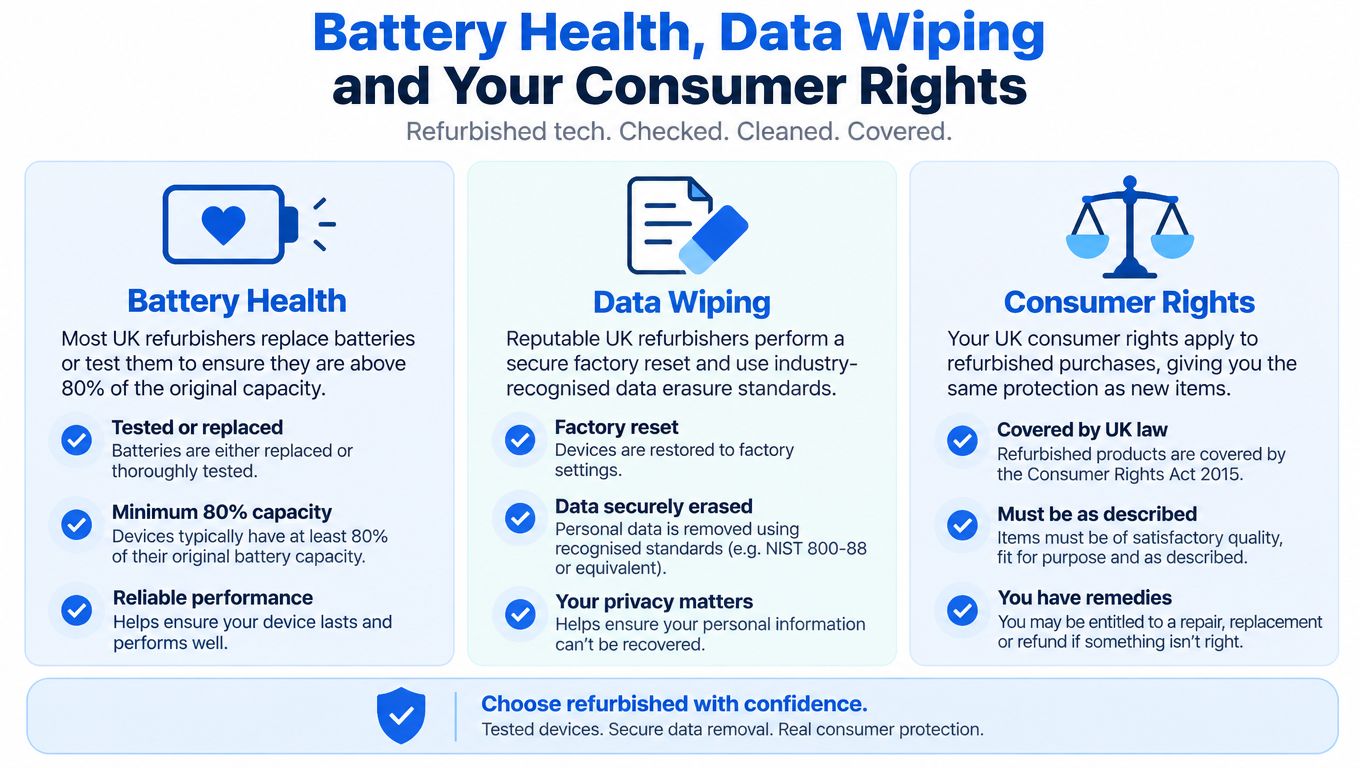
A good refurbishment has three trust signals that buyers can verify: the battery has been assessed, the previous data has been removed and the retailer explains what happens if the phone develops a fault.
Battery health is about usable time
Lithium-ion batteries lose capacity as they go through charge cycles. A handset at 80% battery health still holds about four-fifths of its original charge storage, but it may show noticeably shorter peak endurance than a new phone. Some UK retailers use 85% as a stricter minimum, so ask which standard applies rather than assuming every refurbished listing is comparable. O2's battery guidance sets out why the threshold matters in everyday use.
On an iPhone, check Settings > Battery > Battery Health and Charging after setup. Android menus vary by manufacturer, so a retailer should be able to explain the diagnostic or test result used. Battery cover also matters. A warranty that covers the handset but excludes normal battery deterioration isn't the same as a separate battery guarantee.
Wiping protects the next owner
A proper process removes the previous owner's accounts and personal information, then resets the phone so it starts at the setup screen. That's more than signing out of one Apple ID or Google account. The technician must also check activation locks and management restrictions, because a phone that still belongs to somebody else's account isn't ready for resale.
What the law means in practice
The Consumer Rights Act 2015 applies when you buy from a trader. The phone must be of satisfactory quality, fit for purpose and as described. Which says buyers have a 30-day right to reject a refurbished phone that fails those tests. After that, the remedy may involve repair or replacement, depending on the fault, timing and circumstances.
A retailer warranty is an additional promise with its own terms. It may explain repair arrangements, exclusions, battery cover and return procedures. A manufacturer warranty, where available, is separate and shouldn't be assumed to provide the same protection for every second-hand handset. The retailer's written policy is the document to check before ordering.
Our Experience Refurbishing This Model at Used Mobiles 4U
There isn't one “refurbished phone” condition. A device can arrive looking almost new and still need a battery, while another may have a marked housing but be mechanically sound. Our technicians assess the handset in front of them rather than treating the model name or grade as a shortcut.
Phones arrive from trade-ins, customer buy-backs and recycling channels in mixed condition. One thing we regularly notice is that the obvious damage isn't always the most important fault. A cracked screen is easy to spot, but lint packed into a charging port, a weak microphone or corrosion around a connector can cause more day-to-day frustration.
What appears on the repair bench
Common findings include cracked screens after drops, batteries affected by heat, worn charging ports, liquid indicator triggers and peeling or swollen back glass on older iPhones. We also see heavy-use signs such as polished speaker grilles, micro-scratches around camera lenses, faded buttons and wear around the edges where a case has trapped grit.
A battery that doesn't meet the stated standard is replaced or the handset is removed from sale. Worn housings, damaged screens and unreliable charging parts are assessed in the same way. The decision isn't just “repair everything”. If the repair cost, parts quality and remaining software life don't make sense together, the phone may be used for parts instead.
Workshop rule: A cosmetic mark can be acceptable. A safety issue, account lock or unreliable core function isn’t.
Parts may come from genuine service channels, premium aftermarket suppliers or other approved sources, depending on the model and repair. The important point is that the replacement part must work correctly and be followed by testing. A screen replacement, for example, isn't finished until touch response, brightness, cameras, sensors and biometric functions have been checked again.
Logic boards, antennas and displays that pass inspection are generally left original. Replacing working components for the sake of making a phone sound more “refurbished” can add cost without improving reliability. The sensible approach is targeted repair, repeat testing and removal from sale when the result doesn't meet the required standard.
What buyers usually ask us
- Will it look new: That depends on the grade. A lower cosmetic grade can show marks even when every main function passes testing.
- Will the battery last all day: No retailer can promise identical usage for every customer. Battery health provides a useful baseline, but brightness, signal, gaming and navigation all change endurance.
- Is an older iPhone still sensible: It can be, if its remaining software support, battery condition and repair history match the buyer’s needs.
- Should I repair my current phone: Compare the repair with the phone’s age, storage, battery and likely future faults. Sometimes a tested replacement is the more practical choice.
What to Check Before You Buy a Refurbished Mobile
Treat the listing like a conversation at the counter. Ask precise questions, and expect precise answers.
- Which grading scale is used: Find out what Grade A, B or C means in that seller’s own words. Look for actual device photos where possible, not only stock images.
- What battery standard applies: Ask for a minimum percentage in writing and check whether the warranty covers battery performance separately.
- Has the IMEI been checked: The handset should be clean, unblacklisted and free from activation or management locks.
- What does the warranty cover: Read the period, exclusions, return instructions and treatment of accidental damage or normal battery wear.
- How was the data removed: The phone should be securely wiped and ready for a fresh setup, not merely signed out of one account.
Red flags include a vague “Grade A” label with no definition, no clear return window, stock photographs that hide the actual condition and a price that seems far below comparable listings. A low price isn't proof of a problem, but it's a reason to check the description, seller identity and protections carefully.
Reassuring signs include a documented test report, transparent grading, a UK trading address and a returns policy that explains the buyer's position. If you're travelling, network compatibility matters too. This guide to an unlocked iPhone for travel explains how to check whether a handset can accept another SIM.
A common example we see is a buyer choosing the cheapest listing, then discovering that the saving disappears when the charging port or battery needs attention. The sensible comparison is the total risk, not just the number beside the phone.
Is a Refurbished Mobile Worth Buying
For many UK buyers, yes. Refurbished makes particular sense for parents buying a first phone for a teenager, students who need a dependable handset without paying new-phone money, and businesses supplying several devices while keeping budgets under control.
It also works well for someone who wants a previous flagship. A refurbished iPhone Pro or Samsung Galaxy can provide strong everyday performance, good cameras and useful storage without the cost of the newest release. Choose the grade around your real life. A phone going straight into a protective case doesn't need to look untouched.
Avoid refurbished if you specifically need the latest camera system, the longest possible software-support window or a phone you expect to keep for more than three years without considering battery work. It may also be the wrong option if you're uncomfortable with a shorter retailer warranty than a new handset offers. In that case, new is the clearer choice.
The verdict on what refurbished mobiles means is simple: it should mean a tested, data-wiped and clearly graded phone, not merely a used handset with a fresh listing. Buy from a retailer that states battery health, explains its checks and gives you proper written protection.
Written by James Waterston. 24 years in the mobile phone industry from customer service through to Sales Director of a global repair and recycling company. Now running Used Mobiles 4U for over 8 years.
LinkedIn
Used Mobiles 4 U supplies professionally tested, SIM-free and securely data-wiped phones with clear grading, battery checks, warranty and returns information. Browse the current Used Mobiles 4 U stock, then use the checklist above to choose a refurbished mobile that fits your budget and daily use.
Meta description: Refurbished mobiles means tested, data-wiped phones with clear grading, battery checks and UK consumer rights. Learn what to check before you buy safely.
Looking for a refurbished phone?
Shop professionally tested refurbished iPhones and Samsung phones with 18 month warranty, 30 day returns and free UK delivery.
Browse Refurbished Phones