


SIM Free Phones No Contract: What to Check Before You Buy

18/11/2026

35 Mins

A SIM-free phone is bought outright, isn't tied to a single network, and takes a SIM card from any UK provider, so you choose the airtime separately with no handset contract attached. Buying the handset and the airtime as two separate costs still works out cheaper than the average bundled deal, which carries roughly a 24% premium for putting the phone and the service on one bill.
The popular advice stops there. "Go SIM-free and save" appears in nearly every buying guide, and it's only true when three things hold up. The battery has real life left in it. The handset works on the network you've chosen. And you know how to leave your old provider without paying twice for the same month.
Get any one of those wrong and the saving disappears into a repair bill, a replacement SIM or a month of overlapping charges. Everything below is about getting those three right before you compare a single price.
How SIM-Free Phones Differ From Contract Handsets
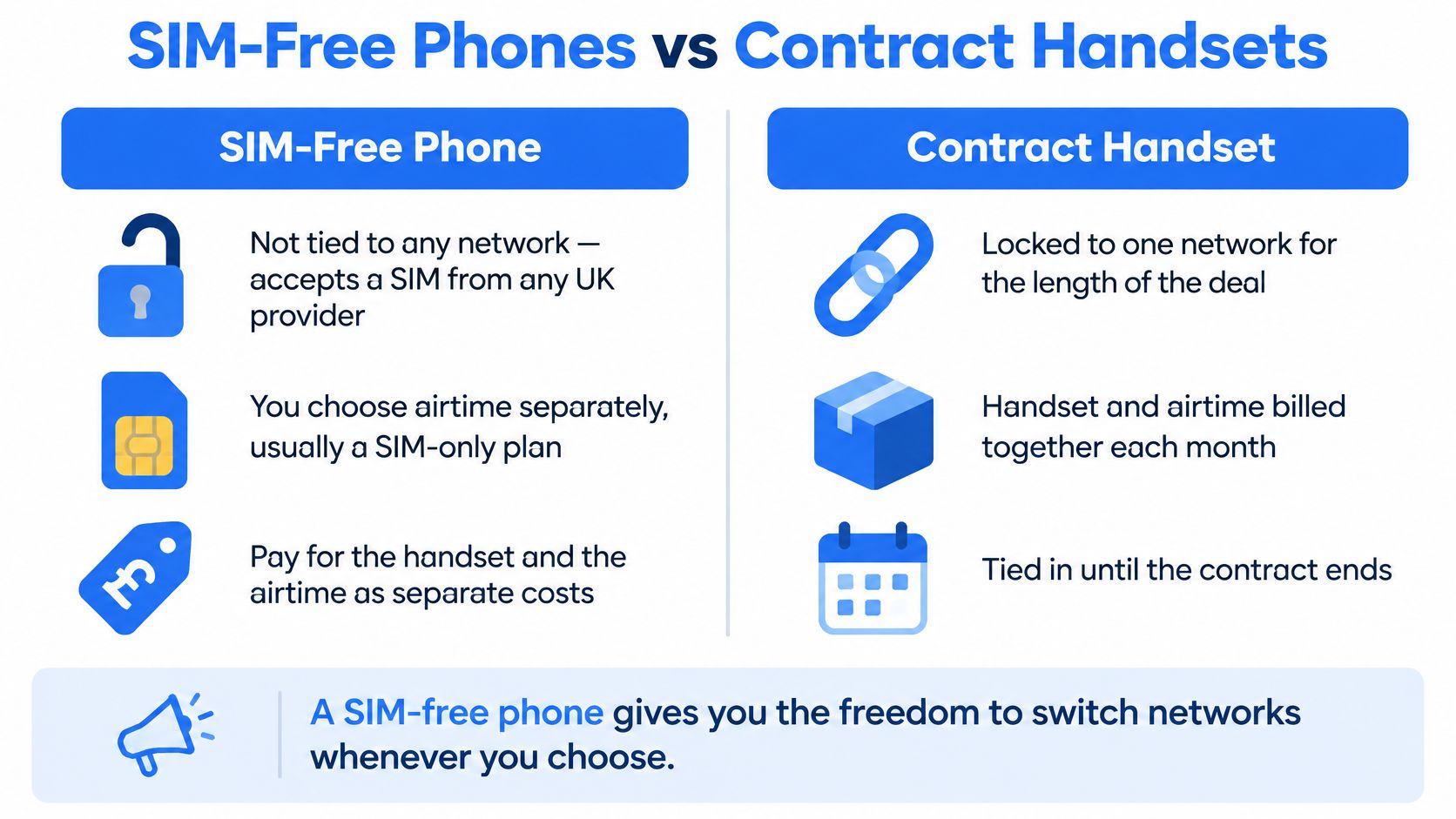
A contract folds two purchases into one monthly payment: the handset and the airtime. SIM-free pulls them apart. You buy the phone once, own it from the day it arrives, then buy calls, texts and data from whichever network suits you that year. The nearest everyday comparison is buying a car outright and arranging your own insurance, rather than leasing one with servicing, breakdown cover and tyres bundled into a direct debit you can't itemise.
The market has moved decisively this way. Ofcom's 2024 pricing analysis found SIM-only services accounted for 44% of all UK mobile subscriptions at the end of Q2 2024, up from 38% in 2023, and 56% of pay-monthly subscriptions, up from 52% (Ofcom, pricing trends for communications services 2024). Ofcom credited part of the growth to people keeping handsets for longer and moving to SIM-only once a bundled deal ended. Its 2020 mobile handset statement had already found that buying a smartphone with mobile service cost, on average, around 24% more than buying a SIM-free phone and using it with a SIM-only deal.
Here's the split in one view.
The only cost test worth running: add up the handset price across the months you intend to keep the phone, then price the airtime on its own. If the total beats the bundled deal you were offered, SIM-free wins. If it doesn't, it doesn't, and flexibility alone won't close the gap.
Checking UK Network Compatibility Before You Buy
The check that catches most problems isn't the price. It's whether the handset is free for any network, and whether it supports the bands your network runs on. A device bought from us works with a SIM from any network provider, including Giffgaff, Tesco Mobile, Asda Mobile and Virgin, but "accepts the SIM" and "works well where you live" are two different questions.
Why 4G is still the safe baseline
Ofcom's coverage research predicted good outdoor 4G coverage from at least one operator across roughly 96% of the UK landmass, with 5G at about 62% (Ofcom on cutting phone and internet bills). That gap is why I'd treat 4G as the reference point for any used handset. A phone with the right LTE bands and working VoLTE holds calls and data almost anywhere. A 5G badge on the box tells you nothing about your street, and nothing at all if the tariff you chose doesn't include 5G access.
Read the coverage checker the way an engineer does
Put the postcode in at the two addresses where the phone will spend most of its life, home and work, plus a university or campus if that's your week. The Ofcom mobile coverage checker shows predicted indoor and outdoor availability and whether signal is likely to be good or variable. Results are modelled in 100 by 100 metre squares, so treat them as a strong hint about the area rather than a promise about the back bedroom.
Four questions to settle before you pay:
- Is it listed as SIM-free, rather than fitted with a network SIM?
- Does the model number point to a UK or EU variant with the right LTE bands and VoLTE support?
- Physical SIM, eSIM or both, and does the plan you want match that?
- What does the checker say about indoor signal at your two main addresses?
A worked example from our own stock is the Samsung A32 5G – White – 64GB – Like New, which we supply without a network restriction and SIM-free, so an existing SIM goes straight in and the on-screen setup takes a couple of minutes. Pairing a handset like that with a rolling plan is the practical version of this check: if coverage disappoints, you change the airtime, not the phone. Our guide to whether refurbished iPhones are unlocked covers the lock question in more detail.
Battery, Storage and Specs That Affect Daily Use
Spec sheets are written for people comparing new phones released in the same year. Buying used, most of those numbers matter far less than a handful of things you can check in the hand or in the settings menu.
Battery health first. It's the percentage of original capacity the cell still holds. We only sell eligible refurbished phones at 85% or above, because below that you notice the difference daily: charging before you leave the house, charging at your desk, charging again at night. On an iPhone the path is Settings > Battery > Battery Health. On Android the route varies by brand, so our phone battery health check guide walks through it.
Storage sets the ceiling. 64GB covers apps, messages and a few thousand photos comfortably. If you shoot video or keep a large music library offline, 128GB is the sensible floor, and paying a little more for it beats deleting things every month.
Camera means very little on paper. Judge real photos in the listing or ask for sample shots, then check focus and that the lens glass is clean when it arrives. Megapixel counts tell you almost nothing about the shots you'll take.
Speed is a battery story. An older flagship with a healthy cell and enough storage often feels quicker day to day than a newer budget handset that's working harder with less headroom.
The charging port decides your cables. Lightning and USB-C aren't interchangeable, and if everyone in the house already owns USB-C chargers, that's a practical reason to favour a USB-C model.
Software support has a shelf life. Check how long the manufacturer has committed to updates for that specific model. Security updates matter more with each year you keep the phone.
If you prioritise only one thing, make it battery health. It's the spec that decides whether a cheap phone stays cheap.
For calls, messages, satnav and photos, the order is battery, then storage, then remaining software support. Camera and raw speed come last, and a clear warranty usually matters more than either. We cover eligible devices with an 18-month warranty and 30-day returns, which is the part of a used purchase people undervalue until something goes wrong.
Our Experience Refurbishing This Model at Used Mobiles 4 U
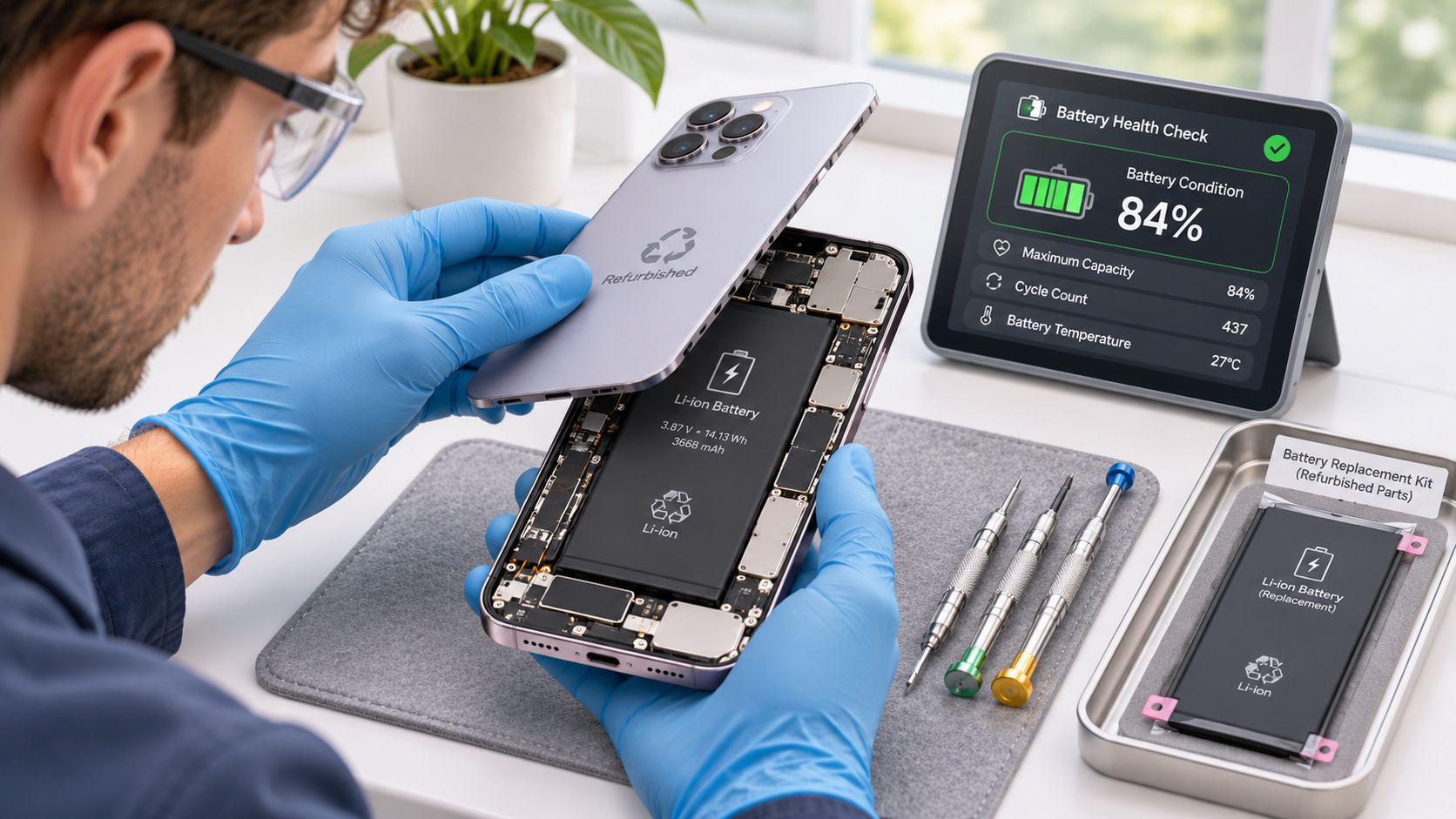
One thing we regularly notice on trade-ins is that the battery tells the truth about a phone faster than the cosmetic grade does. A handset can arrive with a clean screen and a straight frame and still be down to 78% health, at which point the honest answer is a battery replacement, not a new phone. Our technicians often see the same pattern across iPhones, Samsung Galaxy models and Motorola devices: nothing broken, one part tired.
Grades describe appearance, not behaviour. A lower cosmetic grade with light scuffs on the frame and a fresh battery will outperform a cosmetically perfect phone with a worn cell every day of the week. When people ask whether the cheaper grade is a risk, the answer is that the battery report matters more than the photographs.
What we replace most often. Batteries first, by a wide margin, then charging ports worn loose by years of plugging in and out, then screens cracked at the corners from a drop onto a hard edge. Rear glass comes up on older iPhones. We repair when the cost makes sense against the value of the phone and remove anything from sale that doesn't meet the standard.
Signs of heavy use to look for yourself. Scuffed frame edges, a worn ring around the camera lens, fluff packed into the charging port, corners that have gone slightly rounded. None of these mean the phone is finished, but they do tell you it's been carried daily rather than kept in a drawer.
How our technicians decide repair or replace. If the body and screen are sound and the battery is the only failure, that's a repair. If several faults show up together, or anything points to the mainboard, the phone is replaced rather than patched, because intermittent faults come back. Every SIM-free device is checked before it goes out, and the process is set out in our refurbishment process guide.
What the bench check covers. Battery capacity, charging on the port and wirelessly where supported, biometric authentication, both cameras front and rear, speaker and microphone, Wi-Fi and cellular reception, then a secure data wipe before grading and final quality control.
A common example we see is a customer choosing between a three-year-old flagship and a newer mid-range model at a similar price. The older flagship with a verified battery usually wins on screen, camera and long-term software support. The newer phone wins only if the older one's battery hasn't been replaced.
How to Move Your Number to a SIM-Free Phone in Seven Quick Steps
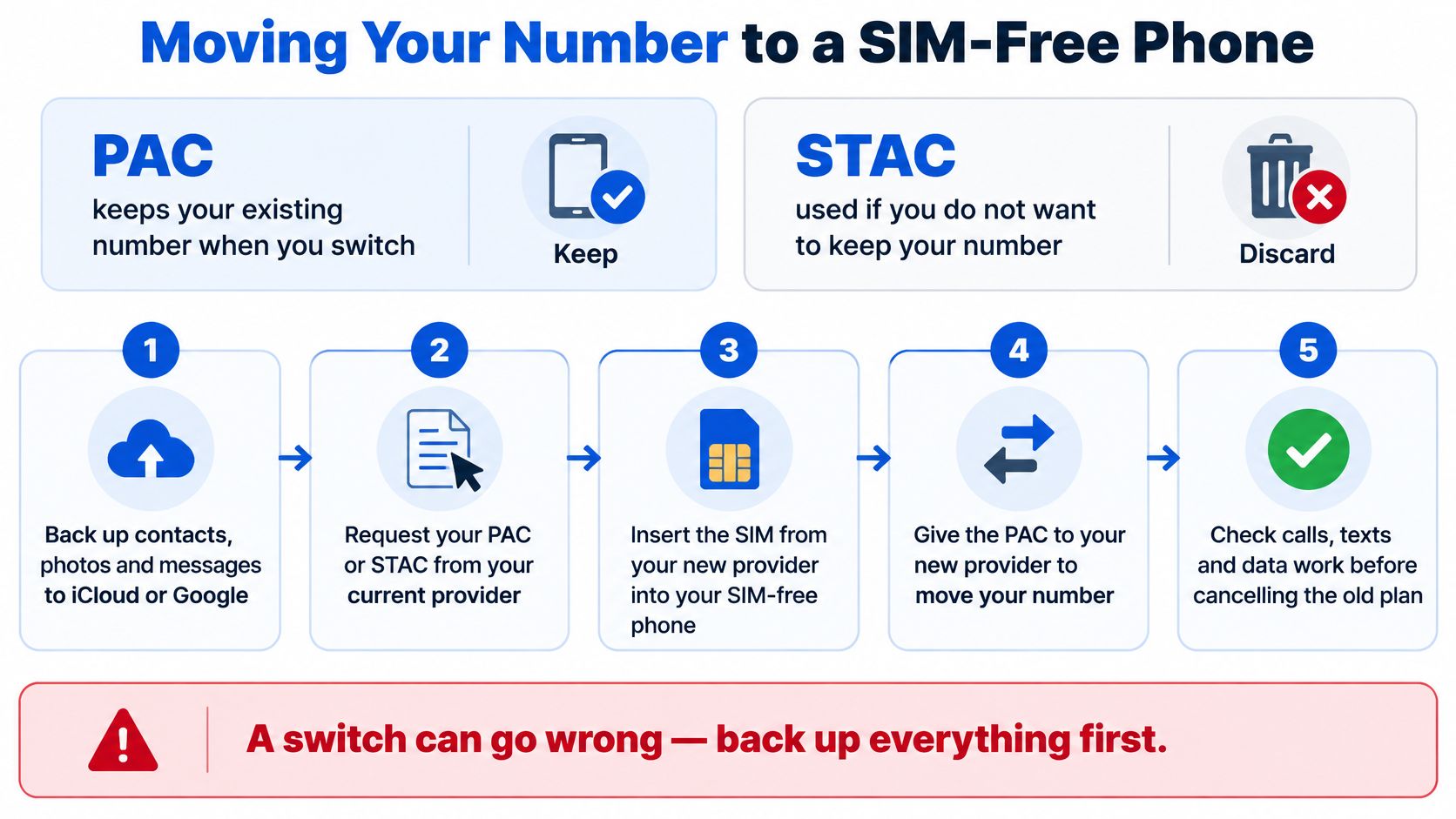
Two codes do all the work here. A PAC keeps your existing number when you switch. A STAC is what you request if you don't want to keep it. Both are free, and neither requires you to finish a handset contract first.
Back up before you touch the SIM tray. Contacts, photos, messages and authenticator apps should already sit in iCloud or Google. A switch that goes wrong is an inconvenience if the data exists elsewhere and a disaster if it doesn't.
- Back up everything. Start with contacts, photos and messages. Our guide to transferring data to a new phone covers the messy parts, including chat history and two-factor apps.
- Request the code. Text PAC to 65075 from the phone holding the number. Providers must supply it immediately over the phone where possible, within two hours by text, or within two working days if you asked by text or online (Ofcom on switching mobile provider).
- Note the expiry. The code stays valid for 30 days. Keep it somewhere other than the phone you're about to stop using.
- Choose the SIM-only plan before you commit. Read the minimum term, the cancellation terms and the price-change rights. A rolling 30-day plan costs a little more per month and is the right pick when you're unsure about coverage.
- Give the code to the new provider. They manage the transfer, which should normally complete within one working day. Most delays happen here: an expired or mistyped code stalls everything, so request a fresh one rather than waiting on a dead reference.
- Fit the SIM and test it properly. Calls out, calls in, texts, mobile data and 4G or 5G at home. Do this before you cancel anything.
- Cancel the old contract last. Providers can't charge for notice periods that run after the switch date, so the overlap charge should be small.
If you're not keeping the number, text STAC to 75075 instead and skip the porting step entirely.
What Buyers Usually Ask Us
Do I need to activate it myself? No. A SIM-free phone from a reputable seller arrives ready to use on any network. If a listing says locked, or says nothing at all about lock status, ask before paying, because a network-locked handset only ever works on one provider.
Is buying refurbished a sensible choice, or a gamble? It's mainstream now. In April 2024, 79% of surveyed UK consumers who planned to purchase a new phone said they would consider a refurbished device, in a Censuswide survey of 2,000 respondents for Vodafone. The gamble isn't the category, it's the seller's grading and testing.
What moves the price? Grade, storage, battery health, cosmetic condition, warranty and availability, in roughly that order. Compare like for like rather than chasing the lowest headline figure on a different grade.
Is the cheapest SIM-free phone always the best value? No. If the battery is tired or the model doesn't suit the network you'll use, a slightly dearer handset with a verified battery is the cheaper phone over two years.
Can I send it back if it doesn't suit? Check the returns terms on each listing before ordering. Ours run to 30 days on eligible purchases, alongside the statutory rights you have anyway.
Run through those five before you shortlist a model, not after you've paid.
Choose a SIM-Free Phone Without a Contract
Is it worth it? For readers here, yes, with conditions. A SIM-free phone with no contract pays off if you keep handsets for two years or more, if you want to change network without asking anyone's permission, and if you've already checked coverage at the addresses where you'll use it. Buy it for those reasons and the maths works. Buy it purely because "SIM-free is cheaper" and you may find yourself holding a phone that can't hold a signal in your own kitchen.
Who should avoid it. If you want one fixed monthly bill with nothing to pay upfront, a bundled deal does that job and the interest is the price of convenience. If you haven't confirmed the handset works on your chosen network, stop and do that first. And if you need a network-specific perk that only exists on a contract tariff, take the contract.
Read the airtime terms properly. Citizens Advice notes that customers who sign up online or by phone generally have a 14-day cooling-off period in which they can cancel without a fee, though contract terms and service-use rules can affect the outcome, and cancellation after that may carry charges set out in the agreement (Citizens Advice on cancelling a phone, TV or mobile contract). Check the minimum term and price-change rights before you commit to the SIM.
Everything we sell is SIM-free, so there's no new contract or tie-in to take on, and eligible phones carry an 18-month warranty with 30-day returns. A current example is the iPhone 12 Mini – Blue – 128GB – Like New, supplied without a network restriction and SIM-free with 128GB of storage, ready for whichever SIM you already hold. One note we give on that generation: an "important display message" can appear on iPhone 11 and 12 models after previous refurbishment work, shows on the lock screen for 7 days, then in settings for 14 days, and clears after 30 days.
Compare sim free phones no contract on your own terms: handset price, verified battery, network compatibility, then airtime.
Buying a SIM-free phone shouldn't mean taking a chance on a mystery handset. At Used Mobiles 4 U every device is tested, securely data-wiped and clearly graded, ready for use with any UK SIM, with an 18-month warranty and 30-day returns on eligible orders. Tell us which network you're on and we'll check the model against it before you pay, so the only thing you're comparing is price.
Written by James Waterston, 24 years in the mobile phone industry from customer service through to Sales Director of a global repair and recycling company. Now running Used Mobiles 4 U for over 8 years.
LinkedIn
A SIM-free phone is bought outright, isn't tied to a single network, and takes a SIM card from any UK provider, so you choose the airtime separately with no handset contract attached. Buying the handset and the airtime as two separate costs still works out cheaper than the average bundled deal, which carries roughly a 24% premium for putting the phone and the service on one bill.
The popular advice stops there. "Go SIM-free and save" appears in nearly every buying guide, and it's only true when three things hold up. The battery has real life left in it. The handset works on the network you've chosen. And you know how to leave your old provider without paying twice for the same month.
Get any one of those wrong and the saving disappears into a repair bill, a replacement SIM or a month of overlapping charges. Everything below is about getting those three right before you compare a single price.
How SIM-Free Phones Differ From Contract Handsets
A contract folds two purchases into one monthly payment: the handset and the airtime. SIM-free pulls them apart. You buy the phone once, own it from the day it arrives, then buy calls, texts and data from whichever network suits you that year. The nearest everyday comparison is buying a car outright and arranging your own insurance, rather than leasing one with servicing, breakdown cover and tyres bundled into a direct debit you can't itemise.
The market has moved decisively this way. Ofcom's 2024 pricing analysis found SIM-only services accounted for 44% of all UK mobile subscriptions at the end of Q2 2024, up from 38% in 2023, and 56% of pay-monthly subscriptions, up from 52% (Ofcom, pricing trends for communications services 2024). Ofcom credited part of the growth to people keeping handsets for longer and moving to SIM-only once a bundled deal ended. Its 2020 mobile handset statement had already found that buying a smartphone with mobile service cost, on average, around 24% more than buying a SIM-free phone and using it with a SIM-only deal.
Here's the split in one view.
The only cost test worth running: add up the handset price across the months you intend to keep the phone, then price the airtime on its own. If the total beats the bundled deal you were offered, SIM-free wins. If it doesn't, it doesn't, and flexibility alone won't close the gap.
Checking UK Network Compatibility Before You Buy
The check that catches most problems isn't the price. It's whether the handset is free to use with any network, and whether it supports the bands your network runs on. A device bought from us works with a SIM from any network provider, including Giffgaff, Tesco Mobile, Asda Mobile and Virgin, but "accepts the SIM" and "works well where you live" are two different questions.
Why 4G is still the safe baseline
Ofcom's coverage research predicted good outdoor 4G coverage from at least one operator across roughly 96% of the UK landmass, with 5G at about 62% (Ofcom on cutting phone and internet bills). That gap is why I'd treat 4G as the reference point for any used handset. A phone with the right LTE bands and working VoLTE holds calls and data almost anywhere. A 5G badge on the box tells you nothing about your street, and nothing at all if the tariff you chose doesn't include 5G access.
Read the coverage checker the way an engineer does
Put the postcode in at the two addresses where the phone will spend most of its life, home and work, plus a university or campus if that's your week. The Ofcom mobile coverage checker shows predicted indoor and outdoor availability and whether signal is likely to be good or variable. Results are modelled in 100 by 100 metre squares, so treat them as a strong hint about the area rather than a promise about the back bedroom.
Four questions to settle before you pay:
- Is it listed as SIM-free, rather than fitted with a network SIM?
- Does the model number point to a UK or EU variant with the right LTE bands and VoLTE support?
- Physical SIM, eSIM or both, and does the plan you want match that?
- What does the checker say about indoor signal at your two main addresses?
A worked example from our own stock is the Samsung A32 5G – White – 64GB – Like New, which we supply ready for use with any compatible SIM, so an existing SIM goes straight in and the on-screen setup takes a couple of minutes. Pairing a handset like that with a rolling plan is the practical version of this check: if coverage disappoints, you change the airtime, not the phone. Our guide to whether refurbished iPhones are unlocked covers the lock question in more detail.
Battery, Storage and Specs That Affect Daily Use
Spec sheets are written for people comparing new phones released in the same year. Buying used, most of those numbers matter far less than a handful of things you can check in the hand or in the settings menu.
Battery health first. It's the percentage of original capacity the cell still holds. We only sell eligible refurbished phones at 85% or above, because below that you notice the difference daily: charging before you leave the house, charging at your desk, charging again at night. On an iPhone the path is Settings > Battery > Battery Health. On Android the route varies by brand, so our phone battery health check guide walks through it.
Storage sets the ceiling. 64GB covers apps, messages and a few thousand photos comfortably. If you shoot video or keep a large music library offline, 128GB is the sensible floor, and paying a little more for it beats deleting things every month.
Camera means very little on paper. Judge real photos in the listing or ask for sample shots, then check focus and that the lens glass is clean when it arrives. Megapixel counts tell you almost nothing about the shots you'll take.
Speed is a battery story. An older flagship with a healthy cell and enough storage often feels quicker day to day than a newer budget handset that's working harder with less headroom.
The charging port decides your cables. Lightning and USB-C aren't interchangeable, and if everyone in the house already owns USB-C chargers, that's a practical reason to favour a USB-C model.
Software support has a shelf life. Check how long the manufacturer has committed to updates for that specific model. Security updates matter more with each year you keep the phone.
If you prioritise only one thing, make it battery health. It's the spec that decides whether a cheap phone stays cheap.
For calls, messages, satnav and photos, the order is battery, then storage, then remaining software support. Camera and raw speed come last, and a clear warranty usually matters more than either. We cover eligible devices with an 18-month warranty and 30-day returns, which is the part of a used purchase people undervalue until something goes wrong.
Our Experience Refurbishing This Model at Used Mobiles 4 U
One thing we regularly notice on trade-ins is that the battery tells the truth about a phone faster than the cosmetic grade does. A handset can arrive with a clean screen and a straight frame and still be down to 78% health, at which point the honest answer is a battery replacement, not a new phone. Our technicians often see the same pattern across iPhones, Samsung Galaxy models and Motorola devices: nothing broken, one part tired.
Grades describe appearance, not behaviour. A lower cosmetic grade with light scuffs on the frame and a fresh battery will outperform a cosmetically perfect phone with a worn cell every day of the week. When people ask whether the cheaper grade is a risk, the answer is that the battery report matters more than the photographs.
What we replace most often. Batteries first, by a wide margin, then charging ports worn loose by years of plugging in and out, then screens cracked at the corners from a drop onto a hard edge. Rear glass comes up on older iPhones. We repair when the cost makes sense against the value of the phone and remove anything from sale that doesn't meet the standard.
Signs of heavy use to look for yourself. Scuffed frame edges, a worn ring around the camera lens, fluff packed into the charging port, corners that have gone slightly rounded. None of these mean the phone is finished, but they do tell you it's been carried daily rather than kept in a drawer.
How our technicians decide repair or replace. If the body and screen are sound and the battery is the only failure, that's a repair. If several faults show up together, or anything points to the mainboard, the phone is replaced rather than patched, because intermittent faults come back. Every SIM-free device is checked before it goes out, and the process is set out in our refurbishment process guide.
What the bench check covers. Battery capacity, charging on the port and wirelessly where supported, biometric security, both cameras front and rear, speaker and microphone, Wi-Fi and cellular reception, then a secure data wipe before grading and final quality control.
A common example we see is a customer choosing between a three-year-old flagship and a newer mid-range model at a similar price. The older flagship with a verified battery usually wins on screen, camera and long-term software support. The newer phone wins only if the older one's battery hasn't been replaced.
How to Move Your Number to a SIM-Free Phone in Seven Quick Steps
Two codes do all the work here. A PAC keeps your existing number when you switch. A STAC is what you request if you don't want to keep it. Both are free, and neither requires you to finish a handset contract first.
Back up before you touch the SIM tray. Contacts, photos, messages and authenticator apps should already sit in iCloud or Google. A switch that goes wrong is an inconvenience if the data exists elsewhere and a disaster if it doesn't.
- Back up everything. Start with contacts, photos and messages. Our guide to transferring data to a new phone covers the messy parts, including chat history and two-factor apps.
- Request the code. Text PAC to 65075 from the phone holding the number. Providers must supply it immediately over the phone where possible, within two hours by text, or within two working days if you asked by text or online (Ofcom on switching mobile provider).
- Note the expiry. The code stays valid for 30 days. Keep it somewhere other than the phone you're about to stop using.
- Choose the SIM-only plan before you commit. Read the minimum term, the cancellation terms and the price-change rights. A rolling 30-day plan costs a little more per month and is the right pick when you're unsure about coverage.
- Give the code to the new provider. They manage the transfer, which should normally complete within one working day. Most delays happen here: an expired or mistyped code stalls everything, so request a fresh one rather than waiting on a dead reference.
- Fit the SIM and test it properly. Calls out, calls in, texts, mobile data and 4G or 5G at home. Do this before you cancel anything.
- Cancel the old contract last. Providers can't charge for notice periods that run after the switch date, so the overlap charge should be small.
If you're not keeping the number, text STAC to 75075 instead and skip the porting step entirely.
What Buyers Usually Ask Us
Do I need to set it up myself? No. A SIM-free phone from a reputable seller arrives ready to use on any network. If a listing says locked, or says nothing at all about lock status, ask before paying, because a network-locked handset only ever works on one provider.
Is buying refurbished a sensible choice, or a gamble? It's mainstream now. In April 2024, 79% of surveyed UK consumers who planned to purchase a new phone said they would consider a refurbished device, in a Censuswide survey of 2,000 respondents for Vodafone. The gamble isn't the category, it's the seller's grading and testing.
What moves the price? Grade, storage, battery health, cosmetic condition, warranty and availability, in roughly that order. Compare like for like rather than chasing the lowest headline figure on a different grade.
Is the cheapest SIM-free phone always the best value? No. If the battery is tired or the model doesn't suit the network you'll use, a slightly dearer handset with a verified battery is the cheaper phone over two years.
Can I send it back if it doesn't suit? Check the returns terms on each listing before ordering. Ours run to 30 days on eligible purchases, alongside the statutory rights you have anyway.
Run through those five before you shortlist a model, not after you've paid.
Choose a SIM-Free Phone Without a Contract
Is it worth it? For many readers here, yes, with conditions. A SIM-free phone with no contract pays off if you keep handsets for two years or more, if you want to change network without asking anyone's permission, and if you've already checked coverage at the addresses where you'll use it. Buy it for those reasons and the maths works. Buy it purely because "SIM-free is cheaper" and you may find yourself holding a phone that can't hold a signal in your own kitchen.
Who should avoid it. If you want one fixed monthly bill with nothing to pay upfront, a bundled deal does that job and the interest is the price of convenience. If you haven't confirmed the handset works on your chosen network, stop and do that first. And if you need a network-specific perk that only exists on a contract tariff, take the contract.
Read the airtime terms properly. Citizens Advice notes that customers who sign up online or by phone generally have a 14-day cooling-off period in which they can cancel without a fee, though contract terms and service-use rules can affect the outcome, and cancellation after that may carry charges set out in the agreement (Citizens Advice on cancelling a phone, TV or mobile contract). Check the minimum term and price-change rights before you commit to the SIM.
Everything we sell is SIM-free, so there's no new contract or tie-in to take on, and eligible phones carry an 18-month warranty with 30-day returns. A current example is the iPhone 12 Mini – Blue – 128GB – Like New, supplied without a network restriction and SIM-free with 128GB of storage, ready for whichever SIM you already hold. One note we give on that generation: an "important display message" can appear on iPhone 11 and 12 models after previous refurbishment work, shows on the lock screen for 7 days, then in settings for 14 days, and clears after 30 days.
Compare sim free phones no contract on your own terms: handset price, verified battery, network compatibility, then airtime.
Buying a SIM-free phone shouldn't mean taking a chance on a mystery handset. At Used Mobiles 4 U every device is tested, securely data-wiped and clearly graded, supplied ready to work with any UK SIM, with an 18-month warranty and 30-day returns on eligible orders. Tell us which network you're on and we'll check the model against it before you pay, so the only thing you're comparing is price.
Written by James Waterston, 24 years in the mobile phone industry from customer service through to Sales Director of a global repair and recycling company. Now running Used Mobiles 4 U for over 8 years.
LinkedIn
A SIM-free phone is bought outright, isn't tied to a single network, and takes a SIM card from any UK provider, so you choose the airtime separately with no handset contract attached. Buying the handset and the airtime as two separate costs still works out cheaper than the average bundled deal, which carries roughly a 24% premium for putting the phone and the service on one bill.
The popular advice stops there. "Go SIM-free and save" appears in nearly every buying guide, and it's only true when three things hold up. The battery has real life left in it. The handset works on the network you've chosen. And you know how to leave your old provider without paying twice for the same month.
Get any one of those wrong and the saving disappears into a repair bill, a replacement SIM or a month of overlapping charges. Everything below is about getting those three right before you compare a single price.
How SIM-Free Phones Differ From Contract Handsets
A contract folds two purchases into one monthly payment: the handset and the airtime. SIM-free pulls them apart. You buy the phone once, own it from the day it arrives, then buy calls, texts and data from whichever network suits you that year. The nearest everyday comparison is buying a car outright and arranging your own insurance, rather than leasing one with servicing, breakdown cover and tyres bundled into a direct debit you can't itemise.
The market has moved decisively this way. Ofcom's 2024 pricing analysis found SIM-only services accounted for 44% of all UK mobile subscriptions at the end of Q2 2024, up from 38% in 2023, and 56% of pay-monthly subscriptions, up from 52% (Ofcom, pricing trends for communications services 2024). Ofcom credited part of the growth to people keeping handsets for longer and moving to SIM-only once a bundled deal ended. Its 2020 mobile handset statement had already found that buying a smartphone with mobile service cost, on average, around 24% more than buying a SIM-free phone and using it with a SIM-only deal.
Here's the split in one view.
The only cost test worth running: add up the handset price across the months you intend to keep the phone, then price the airtime on its own. If the total beats the bundled deal you were offered, SIM-free wins. If it doesn't, it doesn't, and flexibility alone won't close the gap.
Checking UK Network Compatibility Before You Buy
The check that catches most problems isn't the price. It's whether the handset is network-free and supports the bands your network uses. A network-free device bought from us works with a SIM from any network provider, including Giffgaff, Tesco Mobile, Asda Mobile and Virgin, but "accepts the SIM" and "works well where you live" are two different questions.
Why 4G is still the safe baseline
Ofcom's coverage research predicted good outdoor 4G coverage from at least one operator across roughly 96% of the UK landmass, with 5G at about 62% (Ofcom on cutting phone and internet bills). That gap is why I'd treat 4G as the reference point for any used handset. A phone with the right LTE bands and working VoLTE holds calls and data almost anywhere. A 5G badge on the box tells you nothing about your street, and nothing at all if the tariff you chose doesn't include 5G access.
Read the coverage checker the way an engineer does
Put the postcode in at the two addresses where the phone will spend most of its life, home and work, plus a university or campus if that's your week. The Ofcom mobile coverage checker shows predicted indoor and outdoor availability and whether signal is likely to be good or variable. Results are modelled in 100 by 100 metre squares, so treat them as a strong hint about the area rather than a promise about the back bedroom.
Four questions to settle before you pay:
- Is it listed as SIM-free, rather than fitted with a network SIM?
- Does the model number point to a UK or EU variant with the right LTE bands and VoLTE support?
- Physical SIM, eSIM or both, and does the plan you want match that?
- What does the checker say about indoor signal at your two main addresses?
A worked example from our own stock is the Samsung A32 5G – White – 64GB – Like New, which we supply SIM-free, so an existing SIM goes straight in and the on-screen setup takes a couple of minutes. Pairing a handset like that with a rolling plan is the practical version of this check: if coverage disappoints, you change the airtime, not the phone. Our guide to whether refurbished iPhones are unlocked covers the lock question in more detail.
Battery, Storage and Specs That Affect Daily Use
Spec sheets are written for people comparing new phones released in the same year. Buying used, most of those numbers matter far less than a handful of things you can check in the hand or in the settings menu.
Battery health first. It's the percentage of original capacity the cell still holds. We only sell eligible refurbished phones at 85% or above, because below that you notice the difference daily: charging before you leave the house, charging at your desk, charging again at night. On an iPhone the path is Settings > Battery > Battery Health. On Android the route varies by brand, so our phone battery health check guide walks through it.
Storage sets the ceiling. 64GB covers apps, messages and a few thousand photos comfortably. If you shoot video or keep a large music library offline, 128GB is the sensible floor, and paying a little more for it beats deleting things every month.
Camera means very little on paper. Judge real photos in the listing or ask for sample shots, then check focus and that the lens glass is clean when it arrives. Megapixel counts tell you almost nothing about the shots you'll take.
Speed is a battery story. An older flagship with a healthy cell and enough storage often feels quicker day to day than a newer budget handset that's working harder with less headroom.
The charging port decides your cables. Lightning and USB-C aren't interchangeable, and if everyone in the house already owns USB-C chargers, that's a practical reason to favour a USB-C model.
Software support has a shelf life. Check how long the manufacturer has committed to updates for that specific model. Security updates matter more with each year you keep the phone.
If you prioritise only one thing, make it battery health. It's the spec that decides whether a cheap phone stays cheap.
For calls, messages, satnav and photos, the order is battery, then storage, then remaining software support. Camera and raw speed come last, and a clear warranty usually matters more than either. We cover eligible devices with an 18-month warranty and 30-day returns, which is the part of a used purchase people undervalue until something goes wrong.
Our Experience Refurbishing This Model at Used Mobiles 4 U
One thing we regularly notice on trade-ins is that the battery tells the truth about a phone faster than the cosmetic grade does. A handset can arrive with a clean screen and a straight frame and still be down to 78% health, at which point the honest answer is a battery replacement, not a new phone. Our technicians often see the same pattern across iPhones, Samsung Galaxy models and Motorola devices: nothing broken, one part tired.
Grades describe appearance, not behaviour. A lower cosmetic grade with light scuffs on the frame and a fresh battery will outperform a cosmetically perfect phone with a worn cell every day of the week. When people ask whether the cheaper grade is a risk, the answer is that the battery report matters more than the photographs.
What we replace most often. Batteries first, by a wide margin, then charging ports worn loose by years of plugging in and out, then screens cracked at the corners from a drop onto a hard edge. Rear glass comes up on older iPhones. We repair when the cost makes sense against the value of the phone and remove anything from sale that doesn't meet the standard.
Signs of heavy use to look for yourself. Scuffed frame edges, a worn ring around the camera lens, fluff packed into the charging port, corners that have gone slightly rounded. None of these mean the phone is finished, but they do tell you it's been carried daily rather than kept in a drawer.
How our technicians decide repair or replace. If the body and screen are sound and the battery is the only failure, that's a repair. If several faults show up together, or anything points to the mainboard, the phone is replaced rather than patched, because intermittent faults come back. Every SIM-free device is checked before it goes out, and the process is set out in our refurbishment process guide.
What the bench check covers. Battery capacity, charging on the port and wirelessly where supported, biometric authentication, both cameras front and rear, speaker and microphone, Wi-Fi and cellular reception, then a secure data wipe before grading and final quality control.
A common example we see is a customer choosing between a three-year-old flagship and a newer mid-range model at a similar price. The older flagship with a verified battery usually wins on screen, camera and long-term software support. The newer phone wins only if the older one's battery hasn't been replaced.
How to Move Your Number to a SIM-Free Phone in Seven Quick Steps
Two codes do all the work here. A PAC keeps your existing number when you switch. A STAC is what you request if you don't want to keep it. Both are free, and neither requires you to finish a handset contract first.
Back up before you touch the SIM tray. Contacts, photos, messages and authenticator apps should already sit in iCloud or Google. A switch that goes wrong is an inconvenience if the data exists elsewhere and a disaster if it doesn't.
- Back up everything. Start with contacts, photos and messages. Our guide to transferring data to a new phone covers the messy parts, including chat history and two-factor apps.
- Request the code. Text PAC to 65075 from the phone holding the number. Providers must supply it immediately over the phone where possible, within two hours by text, or within two working days if you asked by text or online (Ofcom on switching mobile provider).
- Note the expiry. The code stays valid for 30 days. Keep it somewhere other than the phone you're about to stop using.
- Choose the SIM-only plan before you commit. Read the minimum term, the cancellation terms and the price-change rights. A rolling 30-day plan costs a little more per month and is the right pick when you're unsure about coverage.
- Give the code to the new provider. They manage the transfer, which should normally complete within one working day. Most delays happen here: an expired or mistyped code stalls everything, so request a fresh one rather than waiting on a dead reference.
- Fit the SIM and test it properly. Calls out, calls in, texts, mobile data and 4G or 5G at home. Do this before you cancel anything.
- Cancel the old contract last. Providers can't charge for notice periods that run after the switch date, so the overlap charge should be small.
If you're not keeping the number, text STAC to 75075 instead and skip the porting step entirely.
What Buyers Usually Ask Us
Do I need to remove a network restriction myself? No. A SIM-free phone from a reputable seller arrives without network restrictions. If a listing says restricted, or says nothing at all about its status, ask before paying, because a network-restricted handset only ever works on one provider.
Is buying refurbished a sensible choice, or a gamble? It's mainstream now. In April 2024, 79% of surveyed UK consumers who planned to purchase a new phone said they would consider a refurbished device, in a Censuswide survey of 2,000 respondents for Vodafone. The gamble isn't the category, it's the seller's grading and testing.
What moves the price? Grade, storage, battery health, cosmetic condition, warranty and availability, in roughly that order. Compare like for like rather than chasing the lowest headline figure on a different grade.
Is the cheapest SIM-free phone always the best value? No. If the battery is tired or the model doesn't suit the network you'll use, a slightly dearer handset with a verified battery is the cheaper phone over two years.
Can I send it back if it doesn't suit? Check the returns terms on each listing before ordering. Ours run to 30 days on eligible purchases, alongside the statutory rights you have anyway.
Run through those five before you shortlist a model, not after you've paid.
What to Check on Arrival
The buying is done, so the next job is proving the phone behaves the way the listing said it would. Do this in the first day or two, while a returns window is still open, rather than in week three when a problem becomes an argument.
- Lock status and calls: put your own SIM in, let the phone pick up network settings, then ring a landline, ring it back from another phone, send a text and load a webpage over mobile data with Wi-Fi switched off.
- Battery health against the listing: on an iPhone, Settings > Battery > Battery Health gives you the percentage and tells you whether the phone has flagged a service recommendation. Run one full charge and one full discharge in normal use, because a cell that reports 89% and falls off a cliff at 30% is telling you something the number isn't.
- Charging port under load: plug in the cable you own, not the tidiest one in the drawer, and check it charges with the phone flat on a table and again while you hold it. A port that only works at one angle is on its way out.
- Cameras, speaker, microphone and biometrics: take a photo with each lens, record a voice note, play it back at volume, and test the phone's face or fingerprint recognition several times.
- Signal where you sit: test at home, at work and on the route between them inside the first few days, so a coverage problem surfaces while you can still act on it.
Report faults early. A loose port or a weak battery is a straightforward fix when you flag it in week one and a much harder conversation after a month of use.
Our 30-day returns cover eligible purchases precisely because checking beats hoping, and the 18-month warranty sits behind the faults that only show up later.
Choose a SIM-Free Phone Without a Contract
Is it worth it? For many readers here, yes, with conditions. A SIM-free phone with no contract pays off if you keep handsets for two years or more, if you want to change network without asking anyone's permission, and if you've already checked coverage at the addresses where you'll use it. Buy it for those reasons and the maths works. Buy it purely because "SIM-free is cheaper" and you may find yourself holding a phone that can't hold a signal in your own kitchen.
Who should avoid it. If you want one fixed monthly bill with nothing to pay upfront, a bundled deal does that job and the interest is the price of convenience. If you haven't confirmed the handset works on your chosen network, stop and do that first. And if you need a network-specific perk that only exists on a contract tariff, take the contract.
Read the airtime terms properly. Citizens Advice notes that customers who sign up online or by phone generally have a 14-day cooling-off period in which they can cancel without a fee, though contract terms and service-use rules can affect the outcome, and cancellation after that may carry charges set out in the agreement (Citizens Advice on cancelling a phone, TV or mobile contract). Check the minimum term and price-change rights before you commit to the SIM.
Everything we sell is SIM-free, so there's no new contract or tie-in to take on, and eligible phones carry an 18-month warranty with 30-day returns. A current example is the iPhone 12 Mini – Blue – 128GB – Like New, supplied ready to use with 128GB of storage and no SIM, so you can use whichever SIM you already hold. One note we give on that generation: an "important display message" can appear on iPhone 11 and 12 models after previous refurbishment work, shows on the lock screen for 7 days, then in settings for 14 days, and clears after 30 days.
Compare sim free phones no contract on your own terms: handset price, verified battery, network compatibility, then airtime.
Buying a SIM-free phone shouldn't mean taking a chance on a mystery handset. At Used Mobiles 4 U every device is tested, securely data-wiped and clearly graded, supplied ready to work with any UK SIM, with an 18-month warranty and 30-day returns on eligible orders. Tell us which network you're on and we'll check the model against it before you pay, so the only thing you're comparing is price.
Written by James Waterston, 24 years in the mobile phone industry from customer service through to Sales Director of a global repair and recycling company. Now running Used Mobiles 4 U for over 8 years.
LinkedIn
Looking for a refurbished phone?
Shop professionally tested refurbished iPhones and Samsung phones with 18 month warranty, 30 day returns and free UK delivery.
Browse Refurbished Phones