


SIM Free Phones Meaning: What UK Buyers Need to Know

14/11/2026

10 Mins
A SIM-free phone can still be the wrong phone for your network. The term means the handset is sold separately from a network contract, but real-world compatibility also depends on its supported bands, VoLTE and eSIM features.
A phone's model number matters as much as its lock status. Two versions of the same handset can support different network features, so check the exact model against your chosen provider's requirements before buying. SIM-free tells you how the phone is sold; it does not guarantee every network feature will work.
The Short Version of SIM-Free Phones
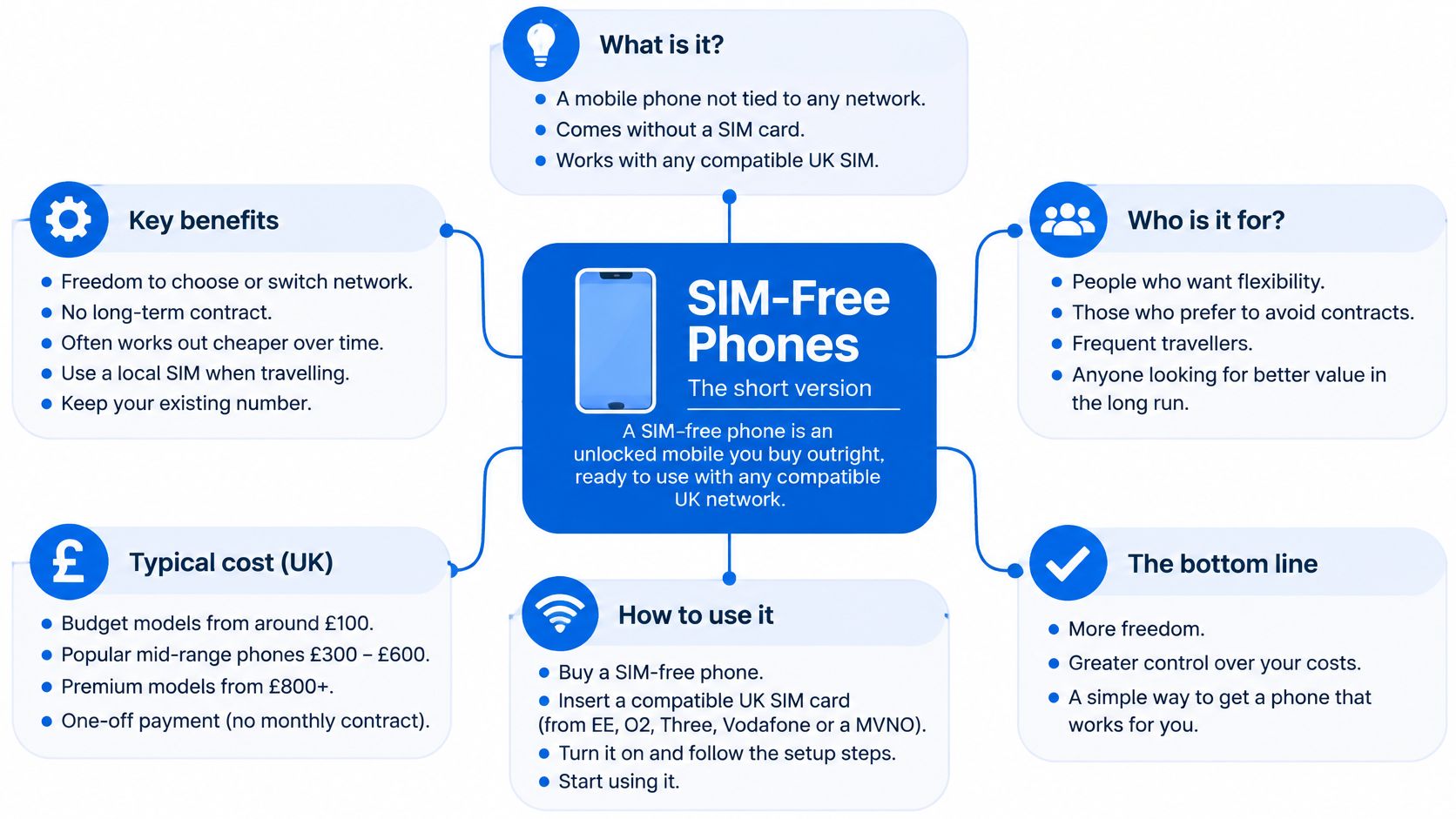
SIM-free describes how the handset is sold, not a guarantee that every feature will work on your chosen network. A phone can accept a UK SIM and still lack the bands, VoLTE support or eSIM compatibility you need.
Before buying, check the exact model number against your network's compatibility information. Then confirm whether you need a physical SIM, an eSIM, or both. For eSIM activation while travelling, Kimsim's eSIM explainer for travelers explains the setup.
A handset kept through two SIM-only deals can spare you from replacing a phone just because you change provider. The trade-off is that you must check the handset's network compatibility yourself, rather than assuming the SIM-free label covers every service.
Older used phones may still have a network lock. Ofcom banned mobile companies from selling locked handsets to residential customers from 17 December 2021 (Ofcom on the locked handset ban), but that rule does not establish whether an older handset is compatible with a particular network.
The takeaway: SIM-free gives you a starting point for choosing a network. Check bands, VoLTE and eSIM support before you buy.
SIM-Free vs Network-Locked Phones Side by Side
A SIM-free phone can still be the wrong choice for your network. The handset's lock status tells you whether it can accept another provider's SIM; it does not confirm that its bands, calling features or SIM format suit your plan.
The practical difference shows up when you change provider. A locked phone may reject another network's SIM; a SIM-free phone can accept it, provided the handset supports that network. Check calls, mobile data and reception with the intended SIM rather than relying on the listing alone.
Used phones need particular care. A handset originally sold on contract may still have a network restriction, so ask the seller to confirm its status. Used Mobiles 4 U sells professionally tested phones that are SIM-free and securely data-wiped, with clear grading. Its guide to what refurbished mobiles means explains how refurbished phones are graded.
For travel, the choice between a physical SIM and eSIM also depends on the handset and destination. This guide to choosing an iPhone SIM for Japan covers that decision. Check the model's network compatibility and SIM options before buying, even when the phone is SIM-free.
Where Bands, 5G and VoLTE Can Break SIM-Free Use
A phone can accept your SIM and still struggle with calls, data or 5G. The exact model variant must support the bands and voice features used by your chosen network.
Bands set the frequencies a handset can use. An imported or older model may show a signal yet have weak 4G service if it lacks bands used by your network. Ofcom warns that switching provider can mean losing 4G functionality when the new network uses unsupported bands.
VoLTE carries calls over 4G. If the phone or network does not support it, calls may fall back to older technology or fail. Strong signal bars do not confirm that calling will work.
eSIM support also depends on the exact model variant, not just the phone's family name. Check this before buying if you need eSIM rather than a physical SIM.
National coverage figures are a starting point, not a prediction for your home. Ofcom's mobile coverage checker update reports 4G availability from at least one network across 96% of the UK geographic landmass, with 4G outside UK premises above 99%. Check the postcodes for your home, workplace and regular routes against the network you plan to use. For travel, read about getting internet access abroad.
A SIM-free Samsung A32 5G, White, 64GB, Like New is still worth checking against your chosen network's band and VoLTE support. Compatibility depends on the phone's exact model and the network features you need.
How to Test a Phone Is SIM-Free, Quick Steps
The label proves nothing. A SIM from a different network proves everything. That's the whole test, and it takes about ten minutes.
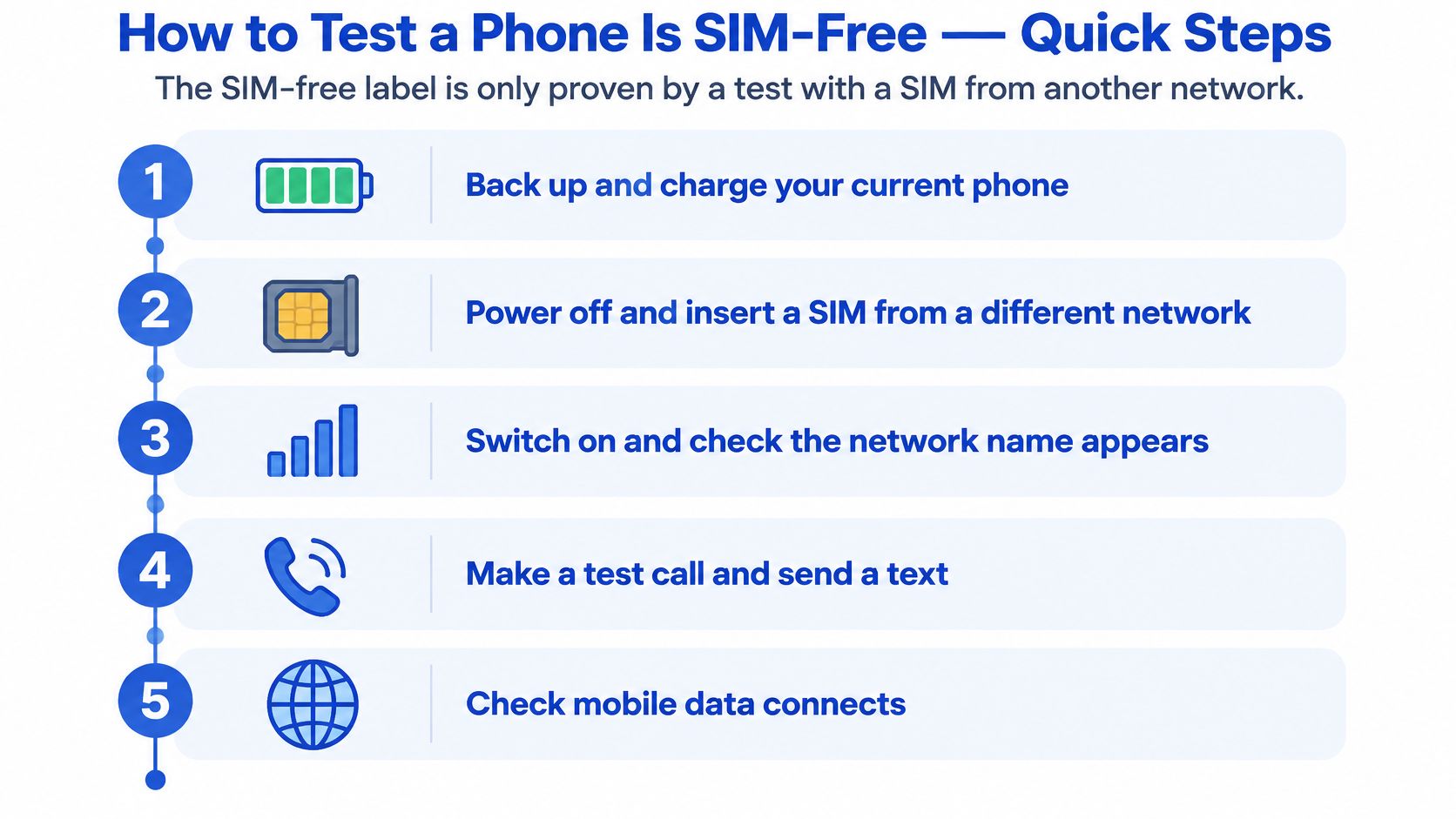
- Back up and charge first. If you're testing your own phone, back it up and keep it above half charge. A factory reset wipes everything, and I'd not run a reset on a device holding photos you haven't copied off.
- Check the model number. On iPhone go to Settings > General > About. On Samsung it's Settings > About phone. Match that exact code against your network's supported bands and VoLTE list. The model name alone isn't enough, because regional variants differ.
- Pull the IMEI. Dial *#06# and note the number. Then check it against a lost or stolen register before you hand over money. A flagged device won't work on a UK network no matter how clean it looks.
- Insert a SIM from a different network. Power off, fit the SIM, power on. Wait for the network name to appear on the status bar. If it shows "No SIM" or "Searching" indefinitely, stop there.
- Make a call and send a text. Both, not one. Voice and SMS travel different paths, and a phone can do one without the other.
- Load a page on mobile data for two minutes. Turn Wi-Fi off first. Watch whether it holds a 4G or 5G indicator through the whole two minutes, not just at the start.
- Sign in with your own account. Confirm the previous owner's Apple ID or Google account is gone. An activation lock is worse than a network lock, and no seller should hand over a phone with one.
What success looks like: bars steady, calls connecting on the first attempt, texts arriving within seconds, and data loading without you watching a spinner.
If the phone drops to 3G during a call, VoLTE isn't provisioned. That's often a network-side setting rather than a fault, but it's worth resolving before you decide the handset is faulty. Our second-hand iPhone buying checklist runs through the rest of the physical checks in the same order.
Does Buying SIM-Free Really Save Money?
Buying SIM-free does not automatically cost less. The handset price and monthly plan need comparing over the same period, including any fees and price rises.
Ofcom's 2023 pricing analysis found that 37% of UK residential mobile users bought handset and airtime together (Ofcom's 2023 pricing trends report). Across six representative connections, buying a phone outright and adding a SIM-only plan saved an average of £6.84 a month, or roughly £164 over 24 months, according to the same analysis.
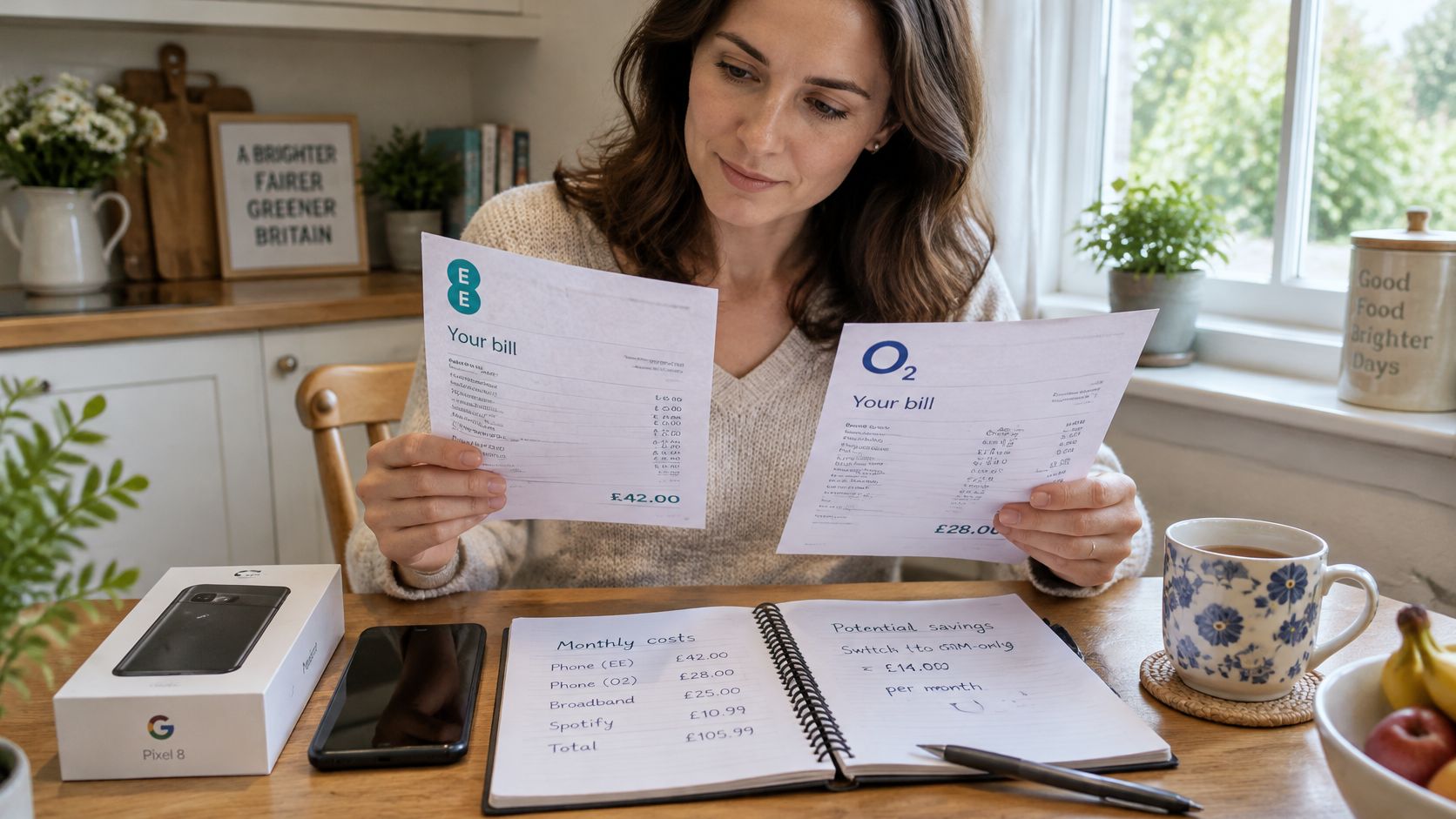
Promotional pricing can change the result. If a SIM-only plan rises after its introductory period, calculate the later monthly payments too. An early-exit fee can also erase savings if you leave a 12-month plan at month four. And a used phone with a worn battery may need replacing sooner, reducing the value of buying it outright.
Flexibility only saves money if you use it. If you prefer one predictable monthly payment and are unlikely to switch plans, a contract may suit your budgeting better. Compare the total cost, not just the upfront handset price or the first month's bill.
If you're keeping your number when you move, ask for a PAC. Providers must supply it within one minute, and it remains valid for 30 days, according to Ofcom's general conditions on switching.
Our Experience Refurbishing This Model at Used Mobiles 4U
SIM-free is a starting point, not a guarantee of service on every network. A handset can accept a SIM and still have limited coverage or calling features if its bands or VoLTE support do not match the network. Check those details for the exact model before buying.
Used Mobiles 4 U sells professionally tested, SIM-free phones that are securely data-wiped and clearly graded. Its refurbishment process includes a 50-step check, and eligible refurbished phones meet an 85% minimum battery health. The grade describes condition; battery health and network compatibility tell you more about how the phone may work day to day.
A few practical checks help distinguish a network issue from a handset fault:
- No service or weak signal: check the phone's supported bands against your network's requirements.
- Calls fail despite a working connection: confirm that the model and network support the VoLTE features you need.
- SIM does not work: check that the handset is compatible with your carrier and the SIM is active.
A SIM-free phone is not automatically suitable for every network feature. Check the exact model and your provider's requirements, especially if you rely on 5G, VoLTE or eSIM.
For details on how devices are assessed, read about Used Mobiles 4 U's refurbishment process. Every phone sold is SIM-free, securely data-wiped and clearly graded.
What Usually Affects Value
SIM-free status is the starting line. Condition decides the price. Two phones of the same model can sit a grade apart and behave nothing alike in daily use.
- Battery health: we set 85% as our minimum for eligible refurbished phones. A weaker battery means more charging, less usable day and a lower value.
- Storage: higher capacity models tend to hold value better within the same model year. It's the one upgrade you can't add later.
- Cosmetic grade: marks visible at arm's length affect price but not function. A scuffed phone can be the sounder buy.
- Lock and band status: a locked or band-limited handset is worth less to anyone on a different network, which is most buyers.
- Software support: check how long the model still receives updates on the manufacturer's current support pages rather than assuming. An Android phone out of security updates loses value fast.
- Warranty and returns: the terms shown on each listing form part of what you're buying.
The trap is letting one factor stand in for all of them. A clean-looking phone can hide a tired battery, and a visibly worn one can be mechanically perfect.
Charging cable type depends on the model: Lightning on older iPhones, USB-C on newer ones and most Android handsets. Update support decides how long the phone stays useful, and 4G or 5G depends on the bands you checked against your network. If you're moving a device on, our sell my Google Pixel page shows how trade-in works in practice.
Deciding Whether a SIM-Free Phone Suits You
SIM-free gives you freedom to choose a network. It does not guarantee that every feature will work: the phone's bands, VoLTE and eSIM support still need to match your provider.
It suits you if you change tariffs more often than phones, travel and want to use a local SIM, or need two numbers. Check the specific model before relying on eSIM or dual-SIM support. A SIM-free handset may lack the network bands or calling features you need.
A network-locked phone may suit you better if you prefer one fixed payment for the handset and service, or need the lowest upfront cost. Either way, compare the total cost and make sure the phone supports your chosen network.
Before buying, check the model's compatibility with your provider and confirm its SIM-free status. For a used phone, review its condition grade and the warranty and returns terms on the product page.
Used Mobiles 4 U sells professionally tested, SIM-free used and refurbished phones, including iPhones and Samsung Galaxy models. Its refurbished phones come with an 18-month warranty. If you want a handset with SIM-free status that's been tested rather than assumed, browse the refurbished iPhones and Samsung Galaxy phones. Each device is checked before dispatch, data-wiped and clearly graded. Free UK delivery is available on refurbished iPhones and Samsung phones.
Looking for a refurbished phone?
Shop professionally tested refurbished iPhones and Samsung phones with 18 month warranty, 30 day returns and free UK delivery.
Browse Refurbished Phones